How Riding an E-Bike Can Boost Employee Wellness and Productivity

How Riding an E-Bike Can Boost Employee Wellness and Productivity

HOW: Riding an E-Bike Can Boost Employee Wellness and Productivity

Riding an e-bike is a fun and convenient way to get around, but did you know that it also has numerous health benefits for employees?

In addition to reducing the carbon footprint and saving money on transportation costs, e-biking has been shown to have positive effects on both physical and mental health. Recent studies highlight the benefits of e-bike use as one specific way to change commuter habits and in turn to improve health and well-being among urban and regional populations.  Let’s take a closer look at the health benefits of riding an e-bike for employees.

Physical Health Benefits
Travel is an essential part of everyday life for most people, and the adoption of active travel represents an efficient way to increase daily physical activity. Due to a growing body of evidence, the UK National Institute of Health and Care Excellence (NICE) now endorse active travel, with a particular focus on commuting, as a feasible method to incorporate physical activity into daily life to improve public health.

One of the most obvious benefits of riding an e-bike is the physical exercise it provides. To stay healthy, the UK Chief Medical Officers’ Physical Activity Guidelines state that adults should try to be active every day. Over a week, activity should add up to at least 150 minutes (2½ hours) of moderate intensity activity in bouts of 10 minutes or more – one way to approach this is to commute by e-bike.


Due to a growing body of evidence, the UK National Institute of Health and Care Excellence (NICE) now endorse active travel, with a particular focus on commuting, as a feasible method to incorporate physical activity into daily life to improve public health.

While e-bikes provide assistance with pedalling, they still require the rider to exert effort and pedal. This can help employees stay active and increase their daily physical activity levels, which has numerous benefits for overall health. Studies have shown that regular exercise can help reduce the risk of chronic conditions such as heart disease, obesity, diabetes, and even certain types of cancer.

Furthermore, riding an e-bike can be easier on the joints and muscles compared to traditional biking, as the motor assistance can help reduce strain and fatigue. This makes e-bikes a great option for those who may have physical limitations or injuries that make traditional biking difficult. It can also help with weight management and improve overall fitness.

the average UK worker takes 4.5 sick days a year; the average cyclist just 2.4 sick days a year.

Mental Health Benefits
In addition to the physical benefits, riding an e-bike can also have positive effects on mental health. One study examining the health benefits of electrically assisted cycling found that participants who regularly rode e-bikes reported decreased stress levels and increased feelings of well-being. The theme ‘mental well-being’ emerged from the participants’ descriptions concerning the positive effect of riding an e-bike. This is likely due to the combination of exercise, fresh air, and the feeling of freedom and control that comes with riding a bike. Exercise has been shown to improve mood and reduce symptoms of anxiety and depression. This is because exercise releases endorphins, which are chemicals that make us feel good.

Commuting can be stressful, but riding an e-bike can provide a more enjoyable and less stressful alternative to driving or taking public transport. Being outdoors and getting fresh air can also have positive effects on mental health. Moreover, e-biking can be a great way to incorporate mindfulness into a daily routine. Mindfulness involves being present in the moment and paying attention to the surrounding environment. When riding an e-bike, employees can focus on the experience of biking, taking in the scenery and enjoying the ride, which can help reduce stress and anxiety.

Productivity Benefits
Studies have shown that regular exercise can boost cognitive function and improve focus and concentration. Riding an e-bike for carbonless commuting can help employees stay fit, reduce stress levels, and improve mental clarity. In turn, these benefits can help employees be more productive at work by increasing energy levels, improving focus, and reducing sick days. According to research by Sustrans, the average UK worker takes 4.5 sick days a year; the average cyclist just 2.4.

Additionally, riding an e-bike can help employees save time and avoid traffic, making them more punctual and reducing stress associated with being late. This can also improve work productivity, as employees who are less stressed and more punctual are generally more productive. With an e-bike, employees can save on fuel costs, parking fees, and public transportation fees. This can free up extra funds that employees can use to invest in their career or personal growth.

Riding an e-bike to work can provide a range of health and productivity benefits for employees. From timesaving to improved physical and mental health, e-bikes offer a cost-effective and eco-friendly way to commute that can help employees be more productive, efficient, and focused in the workplace. As such, employers may want to consider offering e-bike incentives and amenities, such as free-to-use solar e-bike charging, to help their staff make the most of this clean and carbonless commuting option.

 

Discover how staff at Ashford and St Peter’s are transforming the daily commute for NHS Staff ➔

How Employers Can Promote E-bike Adoption

How Employers Can Promote E-bike Adoption

How
Employers
Can Promote
E-bike Adoption

There are many obvious reasons why employers should encourage their employees to adopt e-bikes for the benefit of the organisation and staff.

E-bikes are the perfect tool to attract many people, who don’t want to be a cyclist, out of the car.

  • Cost savings: E-bikes can be a cost-effective mode of transportation, reducing the costs associated with car ownership, such as fuel, parking, and maintenance expenses.
  • Improved health: E-bikes provide an opportunity for employees to get physical activity, reducing the risk of health problems associated with sedentary lifestyles.
  • Increased productivity: By reducing stress levels and improving overall health, e-bikes can increase employee productivity and satisfaction.
  • Reduced traffic and delays: Travelling by bike avoids traffic delays, so commuters arrive on time and leave the roads for cars who need to be there.
  • Reduced environmental impact: E-bikes produce significantly fewer emissions than traditional vehicles, especially when they are powered by the sun, helping organisations to reduce their carbon footprint and contribute to a more sustainable future.
  • Attraction and retention of employees: By promoting e-bikes, organisations can show that they care about their employees’ health and well-being and may be more attractive to environmentally conscious employees.

According to a recent report by Shimano, examining the attitudes towards e-bike usage, economic factors are seen as the strongest encouragement for buying or using an e-bike more.

 Employers can implement various initiatives and programmes to help their staff switch to carbonless commuting with an e-bike. Providing financial incentives, such as tax benefits, subsidies, or bonuses, for employees who choose to commute via e-bike are seen as the most important factor. According to a recent report by Shimano, examining the attitudes towards e-bike usage, economic factors are seen as the strongest encouragement for buying or using an e-bike more. On average across Europe, 47% see the cost of living as primary motivation and 41% see purchase subsidies as an encouragement to more e-bike use.

Other benefits employers can offer are the provision of secure and convenient bike storage and free-to-use charging facilities for staff who use e-bikes. Allowing flexible work hours to accommodate the needs of e-bike commuters who may need to arrive a little earlier or later due to their mode of transportation. Partnering with local e-bike dealerships to offer discounts and special promotions to employees.

Encouraging the use of e-bikes by setting an example and promoting them as a sustainable and cost-effective mode of transportation. Offering training and support to employees who are new to e-bikes, such as safety training, maintenance workshops, cycling clubs and organised ride events. By promoting e-bike use, employers can help their staff save money, improve their health, and reduce their carbon footprint, ultimately leading to a more sustainable and cost-effective mode of transportation.

Helping employees to adopt e-bikes can have numerous benefits for both the employees and the organisation. Incentives not only make it easier for employees to adopt e-bikes, but they also show that the organisation is committed to promoting sustainable and healthy modes of transportation. By implementing such incentives, employers can create a more productive and engaged workforce while also helping to reduce their environmental impact. So, if you are an employer looking to promote e-bike adoption among your employees, you need to put in place the right incentives that make the transition easier and more appealing.

According to the Bicycle Association, the evidence shows that around half of all trips by e-bike replace a trip that would have been made by car. The time is right therefore for employers to kick-start e-bike uptake with the right incentives and be part of the wider clean transport revolution.


Helping employees to adopt e-bikes can have numerous benefits for both the employees and the organisation.

E-Bikes: As an Affordable Solution to the Cost of Living Crisis

E-Bikes: As an Affordable Solution to the Cost of Living Crisis

E-Bikes: As an Affordable Solution to the Cost of Living Crisis

As the cost of living continues to rise, more people are searching for ways to cut expenses and save money.

A recent survey published by Mintel confirmed that 55% of respondents pointed to petrol/diesel costs, alongside steady increases in public transport bills as a reason to consider the switch to e-mobility.

E-bikes offer significant savings on commuting and transport costs as an alternative to running a car. With the ability to travel further distances than a traditional bicycle, without the need for car maintenance, e-bikes offer an obvious solution to the cost of living crisis. E-bikes are not only helping people save money and live more sustainable lives, but they also have the potential to significantly reshape the transportation landscape.


Here are the key benefits of e-bikes to consider for the cost-conscious consumer:

  • Lower operating costs compared to a car with reduced spending on fuel, maintenance, parking costs, insurance, and repairs.
  • Easier and more affordable transportation for commuting, running errands, and other everyday activities.
  • Improved access to job opportunities: e-bikes can provide people with a reliable and affordable means of transportation, which can improve access to job opportunities, especially for those living in urban areas with high transportation costs.
  • Better health: Regular cycling can help to improve health and reduce healthcare costs, providing a long-term cost benefit to individuals and society as a whole.
  • Reduced dependence on fossil fuels: by using renewable energy sources, such as batteries and solar e-bike charging stations, e-bikes can reduce dependence on fossil fuels.

At Solarcycle, we urge consumers, policymakers, employers and other stakeholders to consider the benefits of e-bikes and to embrace them as a viable option for a more affordable and sustainable future.

As more people recognise the benefits of e-bikes, the adoption of this mode of transportation is likely to increase, making it an important part of the solution to the cost of living crisis. At Solarcycle, we urge consumers, policymakers, employers and other stakeholders to consider the benefits of e-bikes and to embrace them as a viable option for a more affordable and sustainable future.

For consumers, we encourage you to think about the potential savings that e-bikes can offer over cars and public transport, and to give them a try as a way to get around. For policymakers, we ask that you prioritise policies that support e-bikes, including dedicated bike lanes and tax incentives for e-bike purchases. Employers can play a crucial role by providing free-to-use e-bike charging facilities and infrastructure for their employees. By doing so, they not only encourage sustainable transportation options but also promote a healthier lifestyle for their staff. Finally, for other stakeholders, such as urban planners and developers, we encourage you to consider the important role that e-bikes can play in creating more sustainable and liveable communities.

Together, we can work towards a future where e-bikes are a mainstream mode of transportation, helping to reduce our reliance on cars, improve our quality of life, and create a more sustainable, healthier, and equitable future for all.

55% of respondents pointed to petrol/diesel costs, alongside steady increases in public transport bills

NHS Case Study: Transforming the daily commute for NHS staff in Surrey

NHS Case Study: Transforming the daily commute for NHS staff in Surrey

NHS CASE STUDY: Transforming daily commutes of NHS staff in Surrey

With too many cars and too few car parking places, employees and patients at Ashford and St. Peter’s Hospitals have a challenge finding car parking spots.

Drivers scour the car park for parking spaces, causing traffic build-up and frustration. The resulting congestion affects staff, visitors and the local community.

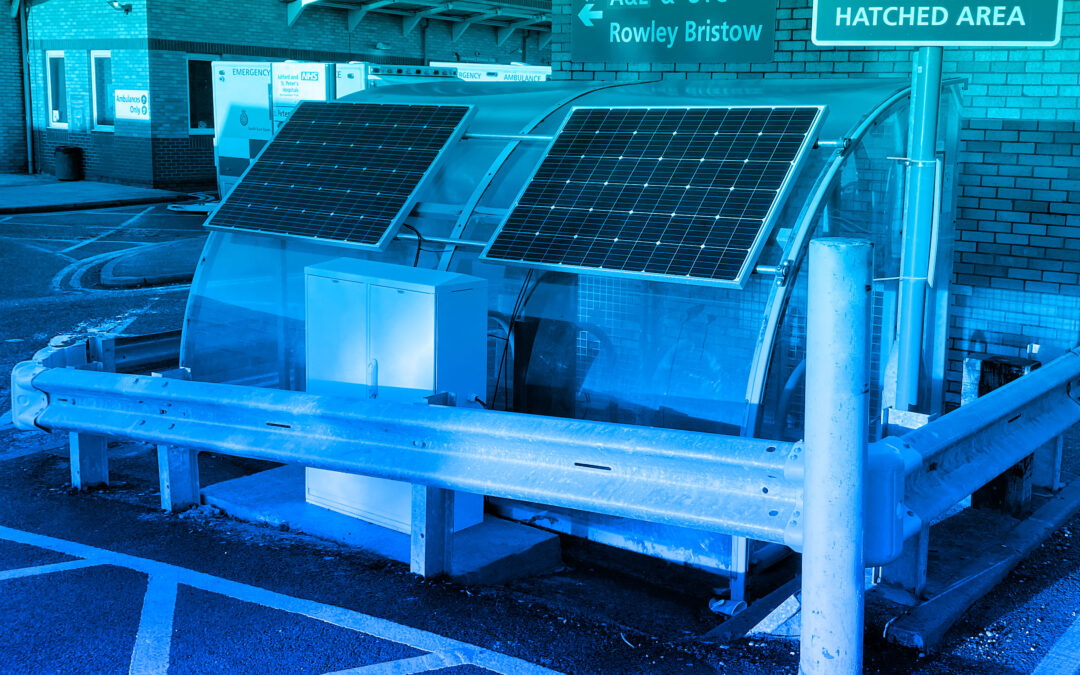
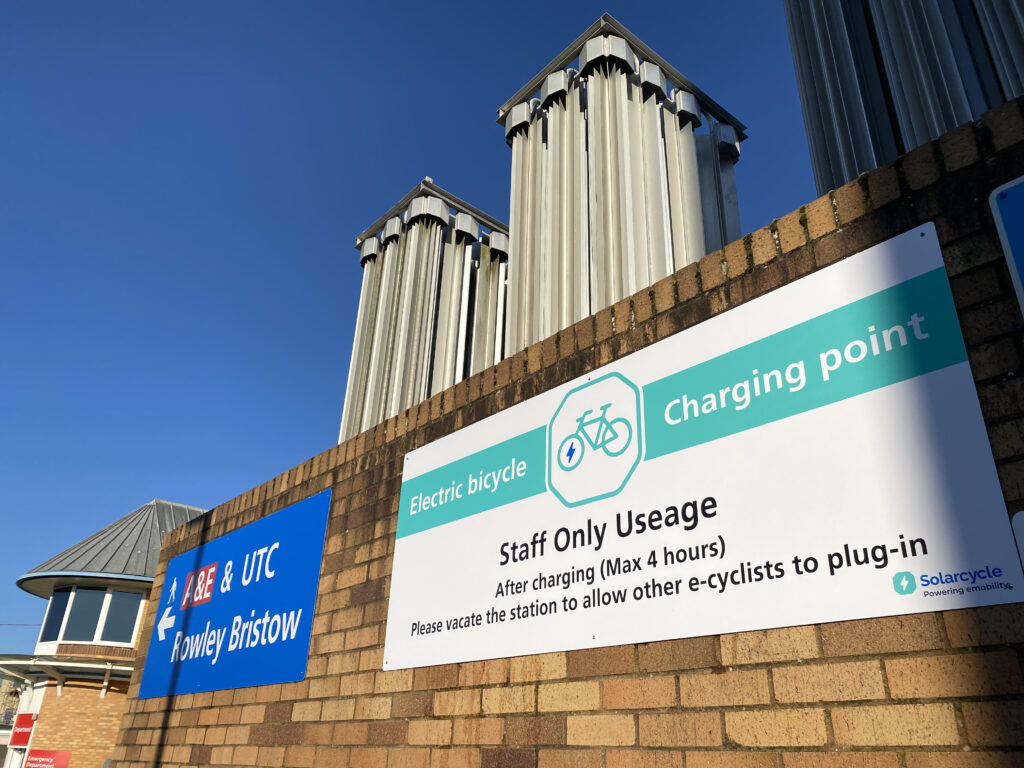
Quick to install and with no need for a mains connection, these solar powered charge points can be up and running in just one day.

Support for car-free commuting

Keen to reduce this problem, the Ashford and St Peter’s Hospital (ASPH) trust encourage car-free commuting with  cycling as a very popular option. Cycle-to-work finance schemes further incentivise ownership of bikes and e-bikes too. Staff now have the opportunity of an easier and cheaper car-free commute than ever before.


Avoiding high costs and disruption

Recognising the benefits of Ebikes, the facilities team at the trust started investigating the potential for Ebike charging points. These would be similar to electric vehicle charging points. However, this was more challenging than they hoped. Installing electric bike charging points is incredibly costly, with an outlay of £20k to just to route electric cables to the charging point, plus the cost of equipment and ongoing electricity supply. The installation would also be very disruptive. Routing electricity means digging up parts of the carpark and on-site road network, causing even more disruption to carpark users.

Solarcycle’s logical alternative

However, there was another solution – one with a fraction of the disruption and vastly lower costs. SolarCycle provides off-grid solar charging for electric bikes. Quick to install and with no need for a mains connection, these solar powered charge points can be up and running in just one day. And because they have no need for a mains connection, the installation and running costs are far lower than mains-connected charge points.

Quickly seeing the potential for SolarCycle’s Ebike charging points, the ASPH trust were keen to find out more. We explained that in addition to the minimal disruption and quick installation, they could provide this service to their staff free of charge – after all, the sun’s energy is readily available. This would be in addition to savings on fuel and parking charges, making the option an increasingly attractive staff benefit. This initiative would also support the Trust’s green targets by providing low carbon transport options.

A UK first for Ashford and St Peter’s Hospitals

The Ebike charging points were installed to the enormous satisfaction of the trust, with Ebike users already taking advantage of the new facilities.

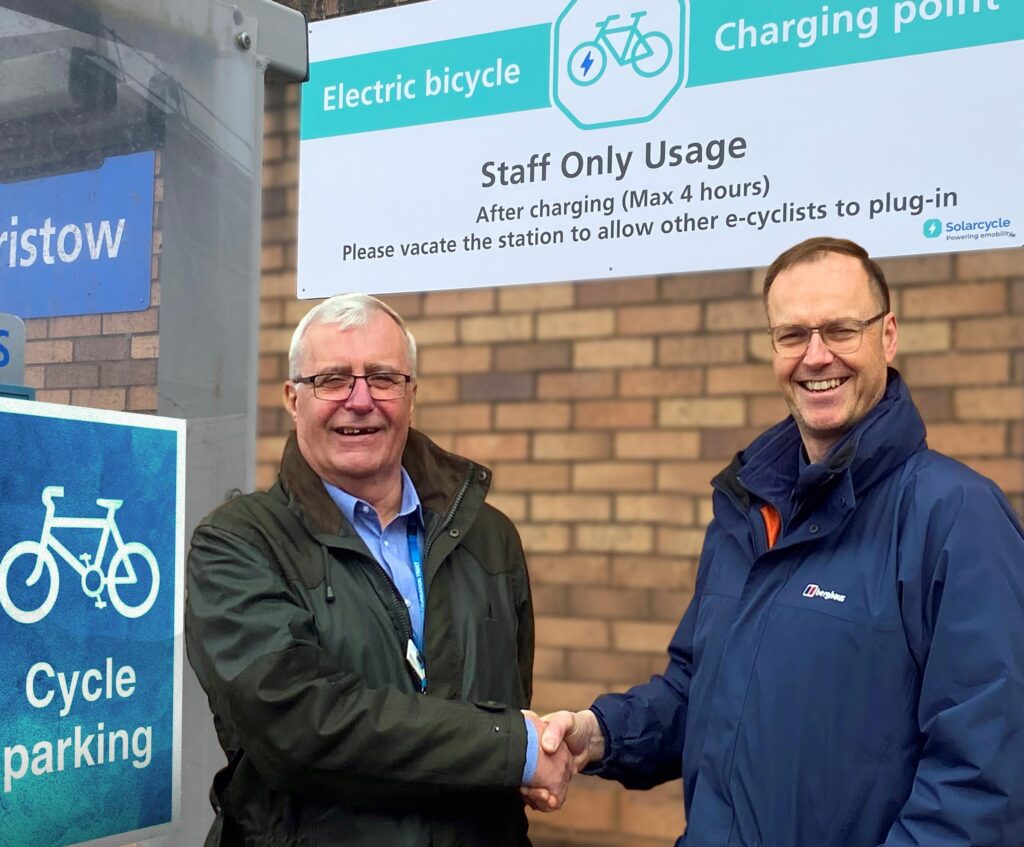
Tom Smerdon, Director of Strategy and Sustainability at ASPH said, “It’s very exciting to see the Ebike charging points being installed here at the Trust, helping us reduce our carbon impact, improve our wellbeing and support local enterprise and innovation.”

E-Bikes: The Secret Weapon for Carbon-Free Commuting?

E-Bikes: The Secret Weapon for Carbon-Free Commuting?

E-Bikes: The Secret Weapon for Carbon-Free Commuting?

Imagine a world where commuting was carbon-free, supported our wellbeing and saved us money.

As well as supporting net zero, cyclists are proven to be less stressed at work, feel more energised and perform better. Cycling charity – Sustrans, discovered that cyclists have nearly half as many sick days compared to non-cyclists.

However, traditional low-carbon commuting is unattractive. Public transport is inflexible. Electric vehicles (EV’s) are expensive. Walking is limited by the distance you live from work and cycling is only for the super-fit or super-committed.

In comparison, a whopping 67.7m tonnes of CO2 is generated by Commuter car traffic in the UK every year. When you consider that the government has committed to reducing the UK’s carbon emissions by 78% in 2035, it’s clear that the daily commute needs reviewing.

Is this really the case?

eBikes are steadily becoming more popular in all age groups. Eradicating limitations like hills, long distances and effort, they’ve quickly become a phenomenon. And the increase in affordable eBike models now means that eBike ownership is realistic for everyone. What’s more, an eBike’s modest energy requirement means commuters can take control and opt out of the spiralling energy costs associated with motor vehicles.

Exploring the Pros and Cons of Commuting by eBike

As well as being more affordable than a car or public transport – no fares, parking or fuel – eBikes allow commuters to incorporate gentle exercise into their daily routine. And as any doctor will tell you, the key to good health is regular movement that fits into our lifestyles. This exercise supports better physical and mental health – this compelling survey found that 74% of people cycling to work saw an increase in physical wellbeing, while 82% of cycling commuters felt less stressed in their jobs. 


Thankfully, Britain is becoming a more cyclist-friendly place with bikes increasing their popularity on our roads. Recent changes to the Highway Code now prioritise cyclists and pedestrians above motorists. And local councils, keen to support green targets, are adding cycle lanes to towns and cities every week.

Perhaps most compelling of all, cycling is fantastically predictable. Have you ever heard of a cyclist being trapped in a traffic jam, or being impacted by train strikes? That predictability means a less stressful commute and a more consistent arrival time at work – a far more positive way to start the day.

Ebike batteries – the stats …

Battery range, or the distance available from the battery causes something called ‘range anxiety’ in the world of electric cars. This actually isn’t as much of a problem as you might think with eBikes. Here’s why:

  • The average UK commute is 10 miles. The average eBike mileage capability is 20 miles. This means there’s enough mileage in a typical eBike to handle a typical commute.
  • A flat battery isn’t the end of the world. Unlike an electric car, you can still use your eBike to get home/to work with no batteries – you just pedal a bit harder and use it like a conventional bike.
  • Forward-thinking workplaces are installing charge points for eBikes, supporting their employees with a healthier, more conscious commute.

Are eBikes the future of carbonless commuting?

In a world where climate anxiety is gathering and people are taking greater ownership over their health, eBikes offer an affordable way for people to take control of their carbon footprint and their lifestyle. Schemes such as Cycle to Work save employees up to 40% on the price of an eBike, making this option even more affordable. 

Could eBikes support the future of carbonless commuting? What’s your view?