A new E-bike charging network for this UK Campus

A new E-bike charging network for this UK Campus

[Case study]

Charging E-bikes for a campus with 32x e-bikes

Safely away from buildings

24th Ocober 2025 – 

Situation: This campus already had a fleet of existing electric scooters with a max range of 4 miles. However, this wasn’t sufficient to cover the 10-mile-wide site and required frequent charging within buildings. 

In summary:

  1. E-scooters with 4-mile range, failed distances.
  2. Policy change: no battery charging in-or-near buildings.
  3. Identified multiple, underutilised analogue cycle shelters
  4. Needed: Secure, safe, outdoor charging & e-bikes.

Solution:
After conducting an audit of the site and its topography and existing vehicles, Solarcycle presented the case for

1. A fleet of Pedal-assisted (pedelec) e-bikes (better battery range & larger, safer and more efficient wheels). We receommended the E28.x from Estarli as it is British made, and maintenance-free, with an auto gearbox and belt drive.

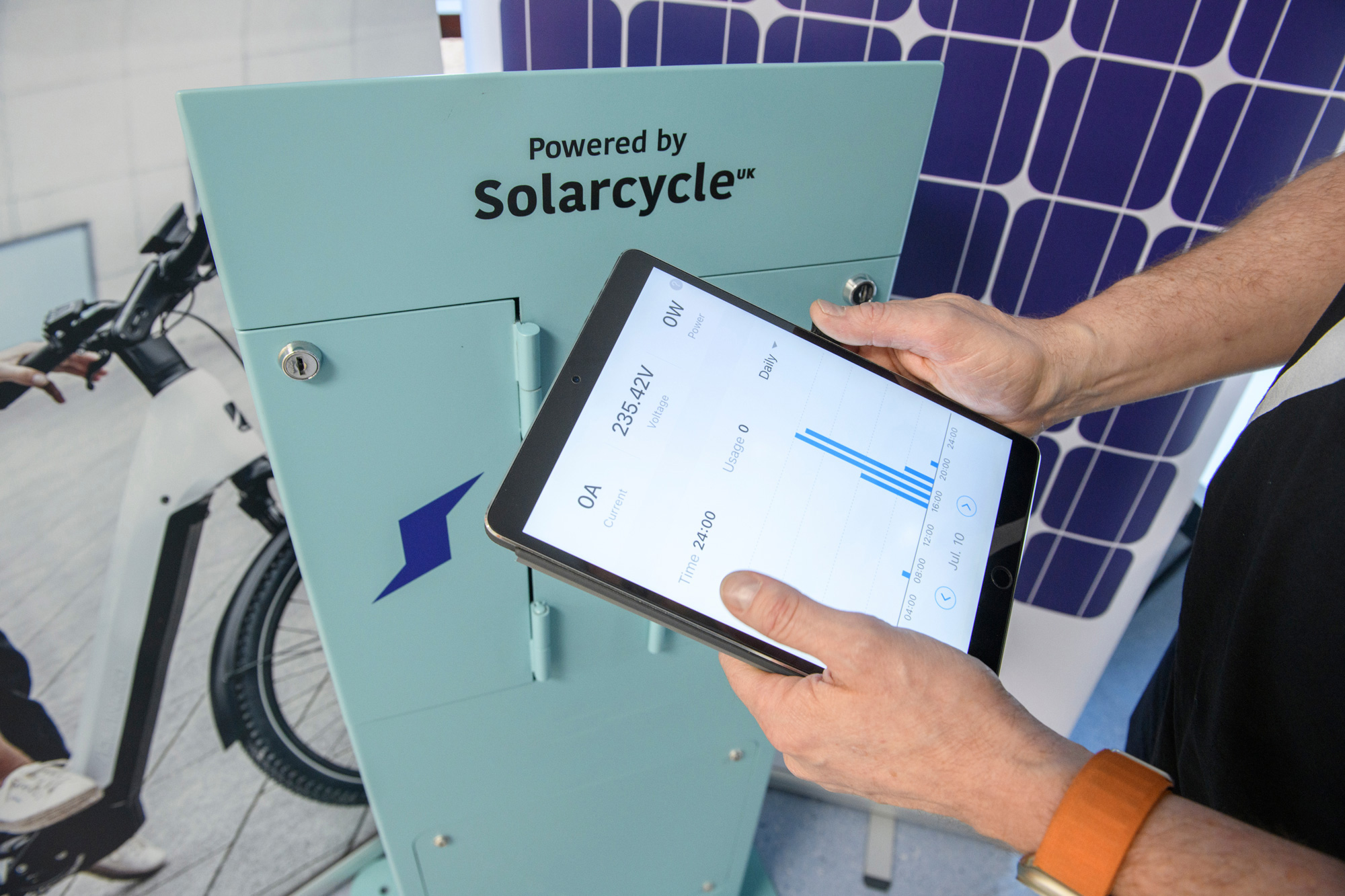
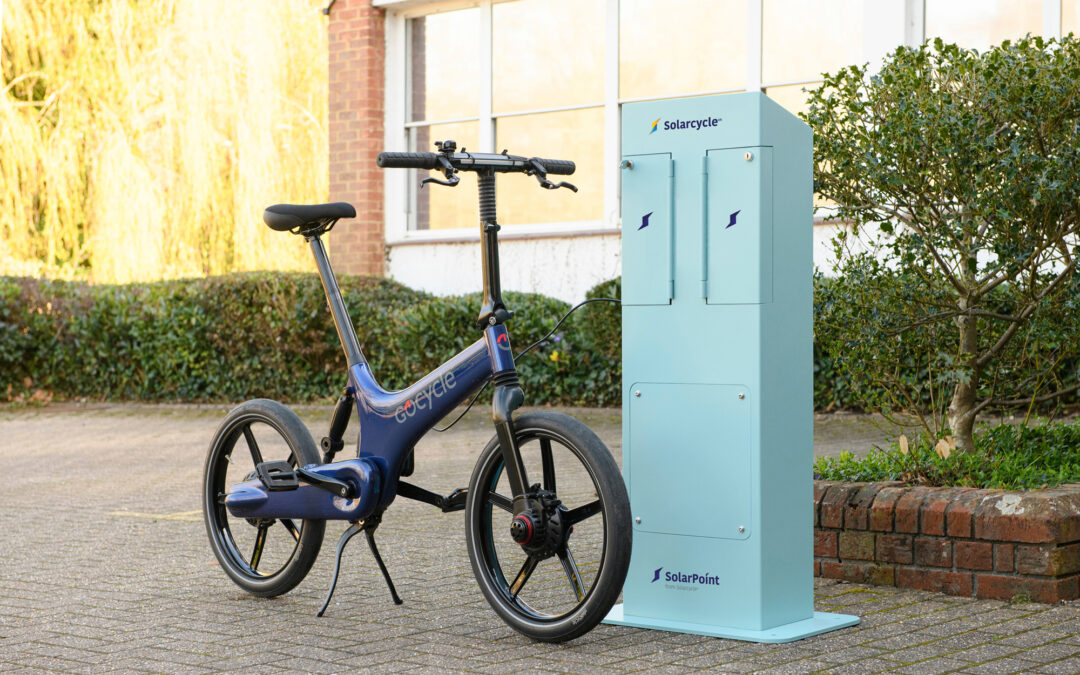
2. Retrofitting some of the existing, under-utlised, cycle shelters with 4x Off-grid solar-powered e-bike charger Totems. We also specified an internal secure SIM & VPN data connection provides private data for reporting.

Results:
The new network of Solar powered E-bike chargers supports multiple brands of e-bikes including the specified Estarli E28.x – mneaing staff and visitors are able to charge up in multiple locations, at any time of night thanks to the available energy stored within the chargers.

Charging per month was configured to suit the local topography, average E-bike battery sizes and likely frequency of use, based on average sessions from across our network. We always over-comensate, to allow for rainy days which we did this time, but the results ar extraordinary. We exceeded the energy requirements by 4× for the project and provided up to 1380km of carbonless travel onsite in the first month. This equaltes to 276x e-bike journeys of 5km. Plus, Remote monitoring, and software updates ensure the chargers are optimal and the lifecycle of components is maximised.

Planning for E-bike Charging?

A Business Case Kit, packed with the latest facts and tools to help you build an internal brief. Essential for Public Sector funding applications.

NHS Case Study with Scope 3 Emissions

NHS Case Study with Scope 3 Emissions

[NHS Case study]

Scope 3 Active Travel Data

+ 8x extra parking spaces for patients and staff

24th Ocober 2025 – 

BF Energy partner with Solarcycle to enhance NHS cycle shelters with 100% Solar powered e-bike chargers in Oxford.

24th October 2025 BF Energy, the specialist energy consultancy are helping Oxford’s NHS Hospitals acheive green the hospital’s Active Travel and Green Plans. BF Energy specified Solarcycle’s NHS Approved e-bike chargers due to their affordability, proven NHS experience and data reporting features.

The latest E-bike charging facility in Oxford marks the 5th NHS site to join Solarcycle’s expanding network of 100% off-grid E-bike chargers and data is proving it to be a huge success.

BF Energy is the Oxford based energy specialist consultancy who have been advising, specifying and implementing leading sustainable solutions within the NHS for nearly 20 years and have contributed to over 1150 mWh’s being saved across the region. Solarcycle impressed BF Energy with it’s award-winning, off-grid, modular e-bike chargers which offer green, renewable energy for e-bikes, safely installed away from buildings and people.

The collaboration between BF Energy and Solarcycle directly addresses the growing switch to active travel in the UK. This partnership avoids the need for charging E-bikes inside buildings, which has proven problematic with some insurers and landlords. Solarcycle’s accessible e-bike charging, provides businesses and organisations like the NHS, with an innovative, safe, and environmentally sustainable solution. And the detailed CO2 analysis for scope 3 emissions reporting has helped inform both Solarcycle and the hospital of staff needs here and elsewhere in the country.

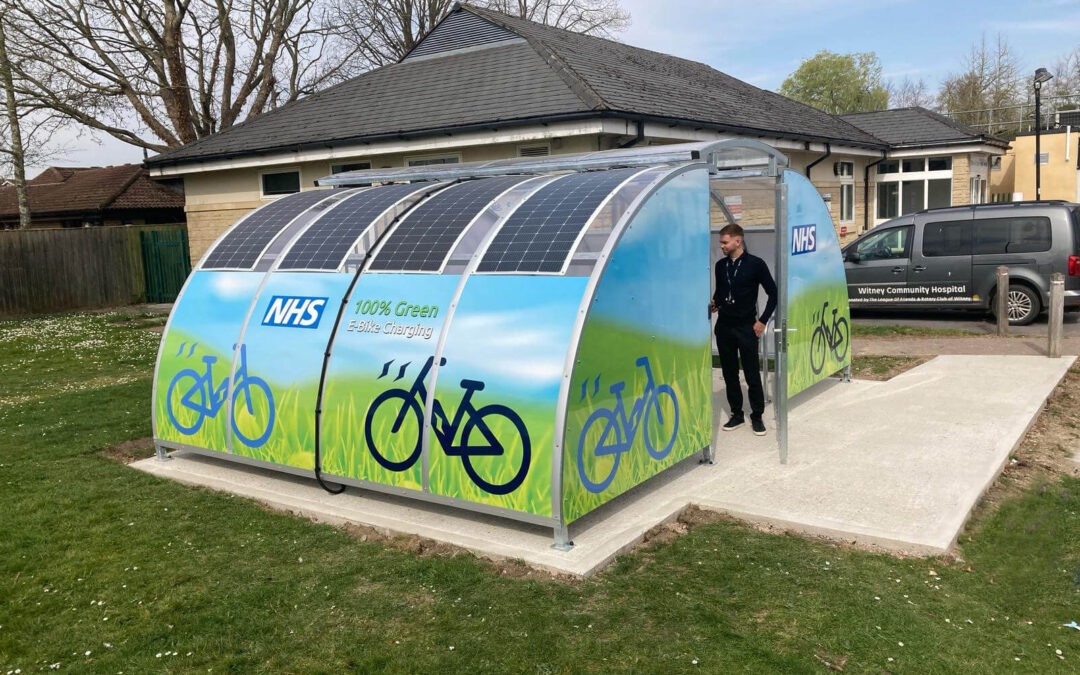
The hospital chose BF Energy to provide the double quarter shelter with Solarcycle’s e-bike charging at NHS Witney Hospital for its immediate environmental benefits and minimal disruption. With a solar-powered and off-grid operation, the charging of e-bikes requires no mains connection or trenchworks and ring-fences energy costs, whilst providing free e-bike charging for all staff.  The collaboration between the two NHS suppliers showcases Solarcycle’s pioneering innovation to evolve as many NHS Cycle shelters affordably into e-bike charging cycle hubs and support businesses like BF Energy and similar organisations in their decarbonisation plans.

The Solarcycle charger and flexible solar panels seamlessly integrate into the curved shelter to provide secure parking AND green energy for upto 28 standard e-bike charges every week. Using Solarcycle’s software dashboard, this data equates to around 840 miles of carbon emitting transport erased from the roads every week. According to Nimblefins ltd, a typical gasoline car produces around 216g of CO2 per mile in the UK, which means NHS staff at NHS Witney Community hospital are set to eliminate thousands of tons of CO2 this year.

With Solarcycle’s unique Reporting Function tracking the kWh of free, 100% renewable solar energy dispensed, it enables organisations to estimate how many carbonless miles have been generated by the organisation. As the only off-grid solar e-bike charging system with this feature, and numerous customers across UK and Europe, Solarcycle sets itself as the market leader.

Understanding the Benefits of Active Travel

Cost Savings for NHS Staff

The average cost of maintaining car is around £319 per month in the UK, plus an average price of between £100and £1000 for leasing/purchasing a car. From fuel costs to parking fees and congestion charges, commuting by car can be a significant financial burden for both employees and employers. In contrast, the ongoing costs associated with e-bikes, such as electricity for charging and periodic maintenance, are just 1p per mile. Moreover, initiatives such as the Cycle to Work scheme provide tax incentives and cost-effective financing options for employers looking to facilitate e-bike adoption among their staff. For example, the lease or purchase cost of an e-bike, compared to a car, is as low as £67 per month through organisations such as the “Green Commute Initiative“.

Cost benefits to the business include the well-being impact of active travel with increased productivity and reduced number of sick days. Absenteeism costs employers £258 per day and the average worker takes 4.5 days off a year, compared to 2.4 days for people who cycle. Regular exercise, even in the form of commuting, has been linked to reduced stress levels and better overall health. Encouraging employees to embrace active travel, particularly through e-bikes, can significantly improve their physical and mental well-being.

Meet CO2 Objectives

Commuting alone contributes to 98% of an individual’s work-related carbon footprint. As many as three million commuters travel as little as two kilometres to work, making an uptick in active travel one of the most actionable ways to drive down corporate emissions.
Businesses dedicated to creating sustainability reports can now easily prioritise assisting employees in switching to e-biking. This becomes particularly crucial with Scope 3 Contractual Emissions Reporting, which encompasses employee commuting, significantly influencing companies’ bids for new work.

E-bikes, when charged with Solarcycle, are the zero-emission mode of transport, emitting no greenhouse gases during operation. Solarcycle stands out in the market with its unique Reporting Function, which tracks the free-to-use, 100% renewable solar energy discharged in kWh and number of Kilometres travelled with zero emissions. This feature empowers organisations to monitor their progress towards sustainability goals and accurately measure their carbon impact.
Planning an E-bike Scheme?

Use our Business Case Kit packed with the latest facts and tools to help you build an internal brief or apply for funding.

Denbies Wine Estate – Solar E-Bike Charging for Sustainable Transport

Denbies Wine Estate – Solar E-Bike Charging for Sustainable Transport

[Case study]

Solarcycle & Denbies Wine Estate

Pioneering Off-Grid Solar E-Bike Charging for Sustainable Transport

18 September 2024 – As the UK’s first Net Zero wine producer, Denbies Wine Estate is a leader in sustainability.

Spanning 265 acres, Denbies is a major player in the English wine industry and a trailblazer in green tourism. Known for its award-winning wines, Denbies earned B Corp accreditation in 2024, reinforcing its commitment to environmental responsibility. To further its eco-friendly initiatives, Denbies partnered with Solarcycle to promote sustainable transport options for visitors through its innovative solar-powered solution.

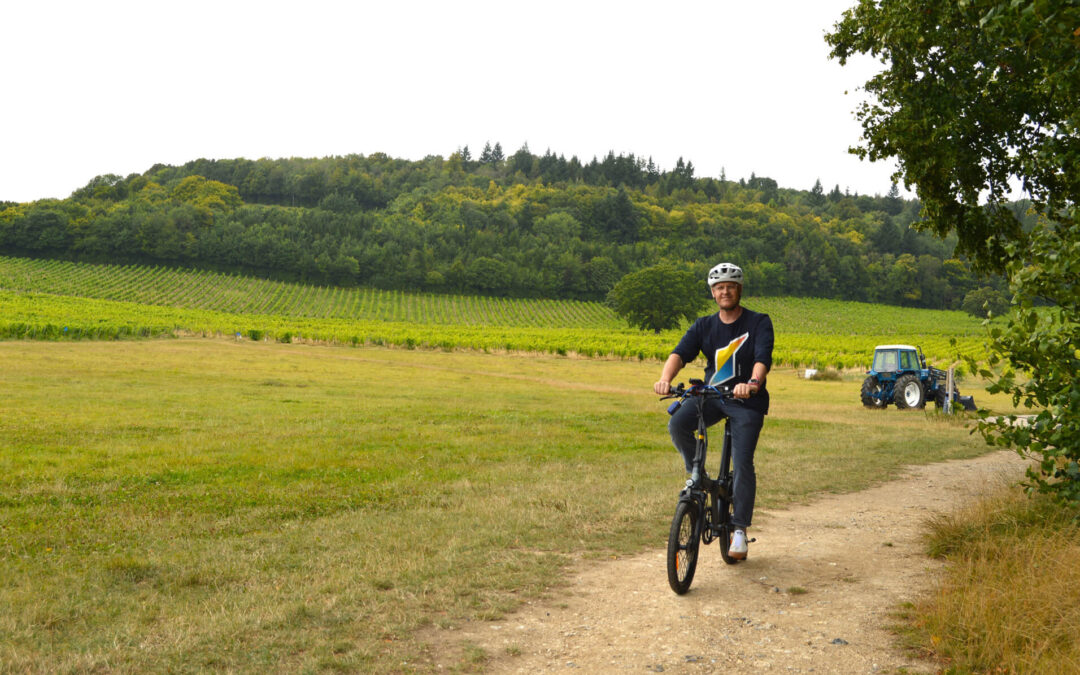
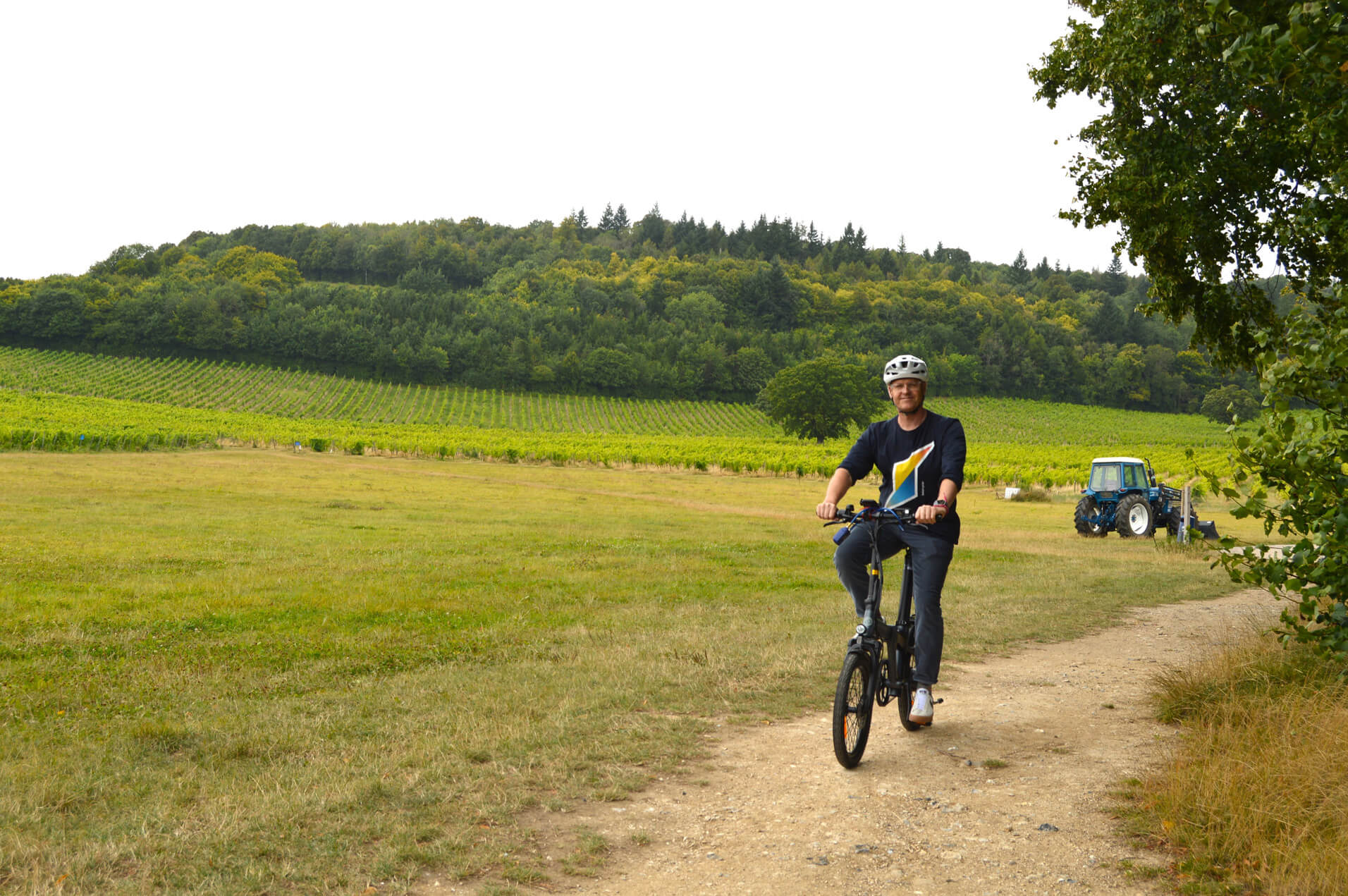
Surrey-based Solarcycle, specialising in modular solar charging solutions, was the perfect partner for this initiative. Together, they aimed to install Surrey’s first commercial off-grid, solar-powered e-bike charging station—providing free, 100% renewable energy for e-bikes at Denbies’ scenic location along the SHNL Greenway Trail.
.

“Our 100% off-grid chargers are perfectly placed at Denbies Wine Estate. This project encourages more people to cycle safely, away from traffic, while enjoying the beautiful Surrey Hills.” added Paul Stratford, CEO of Solarcycle

Planning an E-bike Scheme?

Use our Business Case Kit packed with the latest facts and tools to help you build an internal brief or apply for funding.

Objectives

  • Promote sustainable tourism – by offering free, renewable energy-powered e-bike charging to Denbies visitors.
  • Encourage eco-friendly travel – along the Surrey Hills’ Greenway Trail, reducing car usage and emissions.
  • Support local initiatives – like the SHNL Greenway Trail, Cycling UK, and Surrey County Council’s push for greener transport.
  • Help meet sustainability goals – and set a benchmark for other businesses in the area.

Project Details

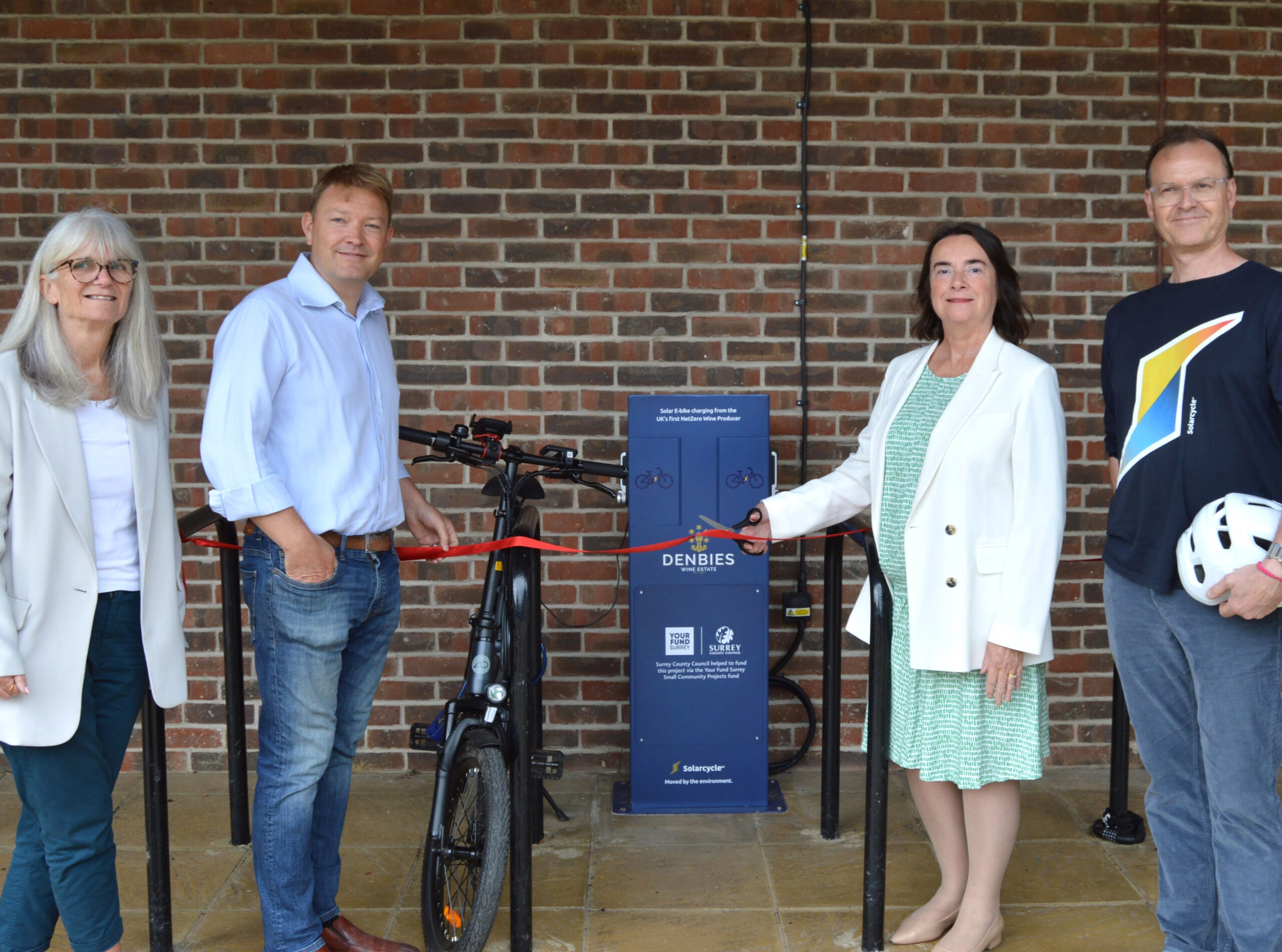
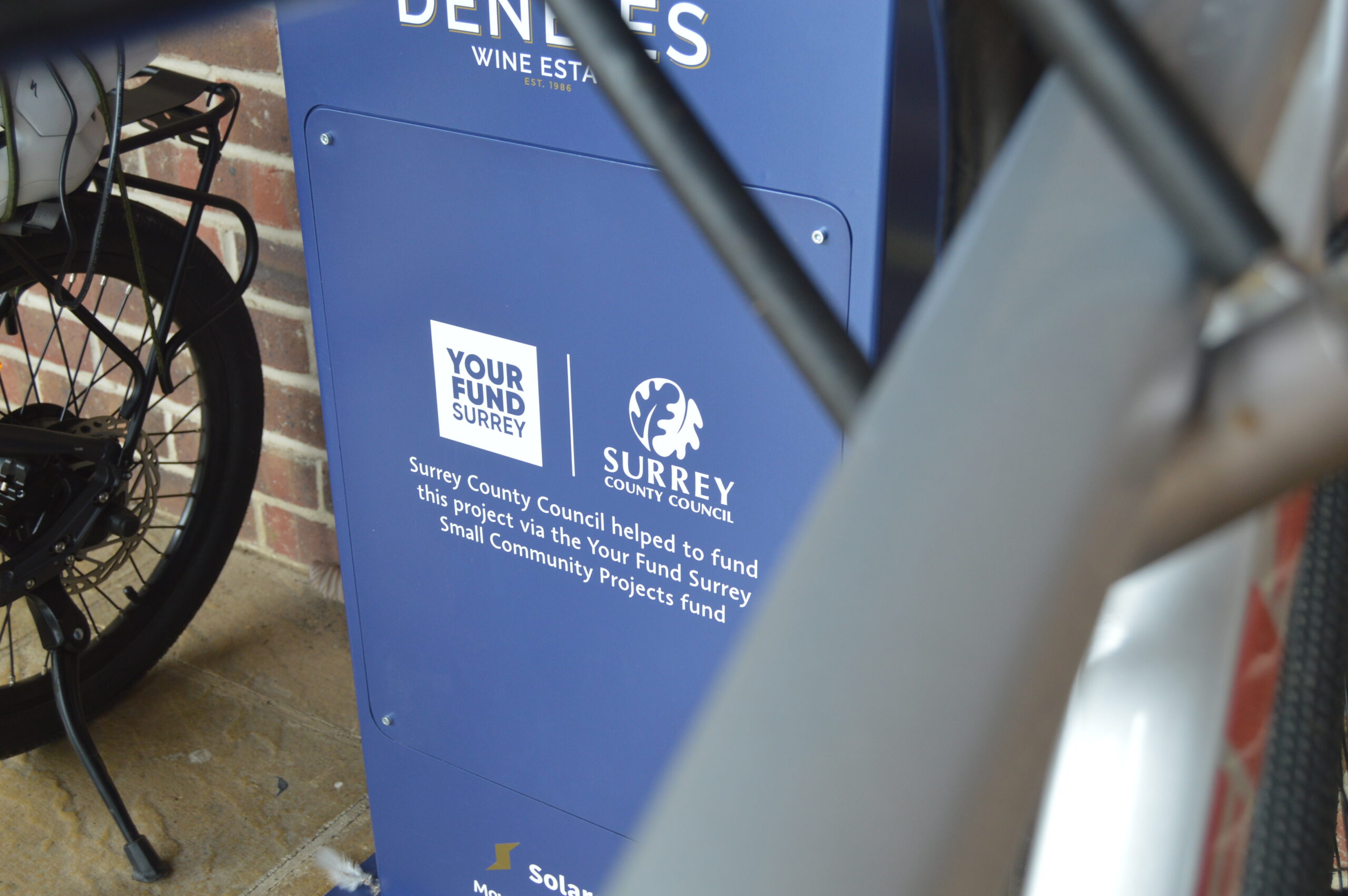
In August 2024, Solarcycle completed the installation of Surrey’s first commercial off-grid solar-powered e-bike chargers at Denbies Wine Estate. The project was partially funded by Surrey County Council’s “Your Fund Surrey” Small Community Projects initiative.

Key components of the project include:

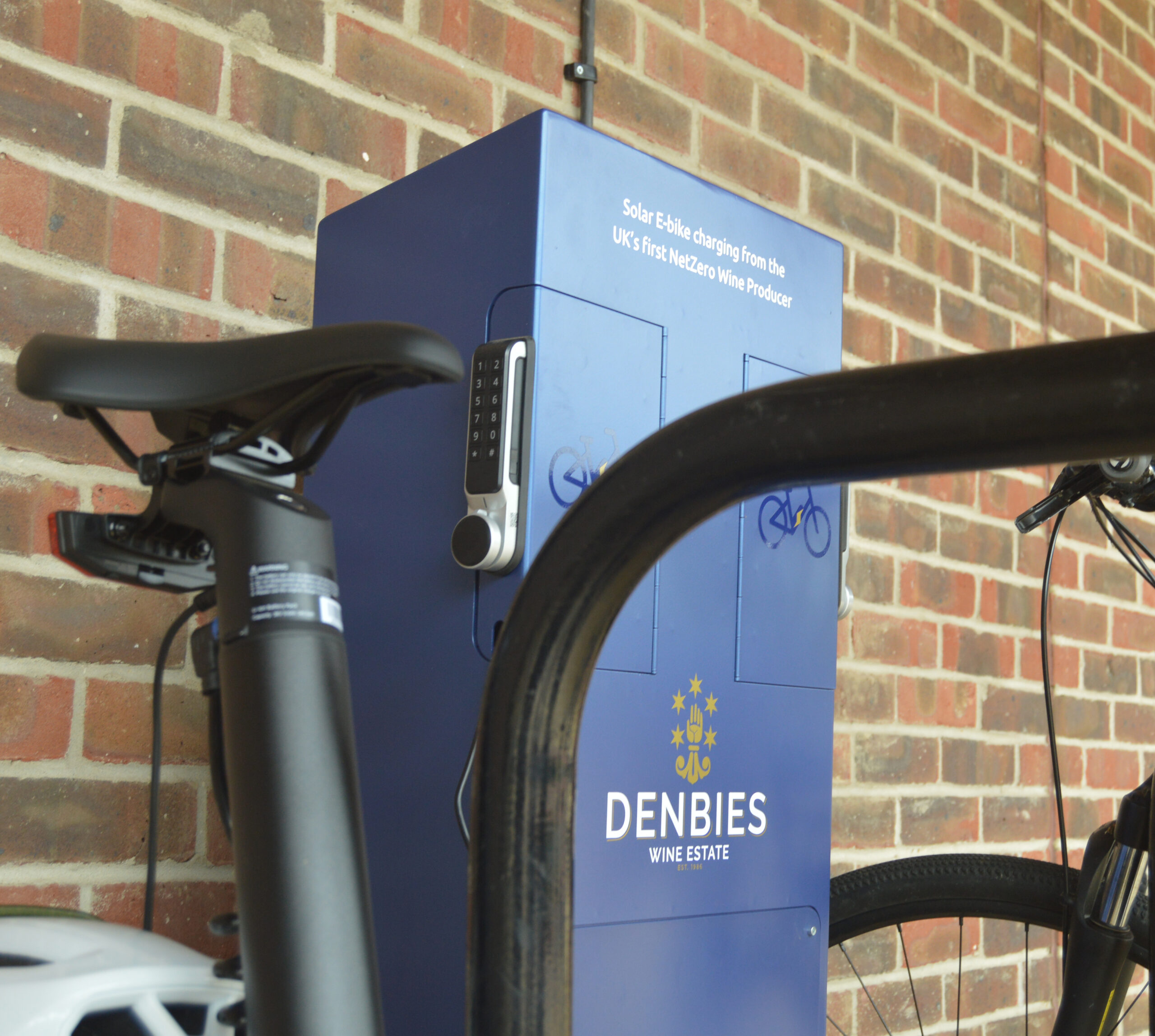
  • Solar-powered, off-grid charging station – providing free energy for e-bikes, reducing emissions and promoting eco-friendly travel.
  • Strategic location – on the SHNL Greenway Trail, a 15km off-road route created by Cycling UK, enabling cyclists to safely enjoy the beauty of the Surrey Hills.
  • E-bike hire – offered at Denbies through Just-Pedal bike hire, allowing visitors to try out e-bikes and experience green travel firsthand.

Key Features and Benefits

  • 100% Renewable Energy: The e-bike charging stations use solar energy, providing free and sustainable power for e-bike users.
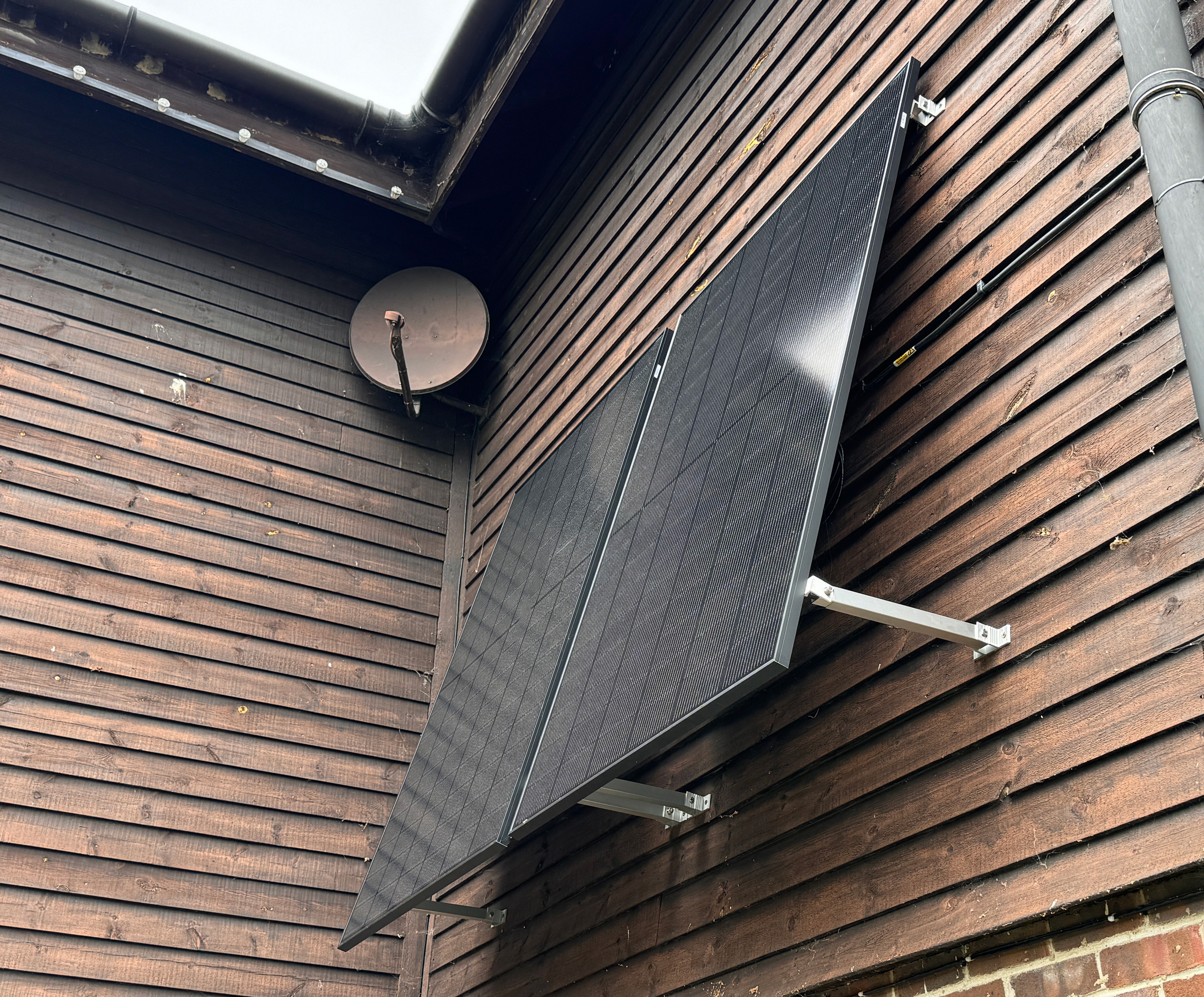
  • No Mains Connection Required: The system is entirely off-grid, eliminating the need for trench works or mains electrical connections. This feature significantly reduces installation disruptions and costs.
  • Environmental Impact: Solarcycle’s unique Reporting Function tracks the kWh of solar energy dispensed, allowing organisations to estimate the carbonless miles generated. This transparency helps organisations monitor and report their sustainability progress.
  • Cost Savings: By generating its own energy, the system incurs no ongoing energy costs, providing a cost-effective solution for e-bike charging.

Challenges

Denbies wanted to not only provide a green alternative for visitors but also reduce road traffic and emissions in the area. As the local roads in Surrey often struggle with high volumes of cars, encouraging visitors to use the Greenway Trail and e-bikes was seen as a key way to minimise the estate’s environmental footprint.
Additionally, the installation needed to align with Denbies’ existing commitment to sustainability, including their recent certifications for Net Zero and B Corp status.

Outcome

The project was a significant success, with the new solar-powered e-bike charging station officially opened by Hazel Watson, Liberal Democrat Surrey County Councillor. This installation has made a meaningful impact in several ways:
Reduced carbon footprint: The off-grid charging station provides 100% renewable energy, helping cut emissions from transportation.

Boost to eco-tourism: The charger encourages visitors to explore the Surrey Hills by e-bike, reducing road traffic and emissions while supporting green tourism.

A model for future installations: Solarcycle’s modular solar charging solution is scalable and adaptable, offering a blueprint for future e-bike charging installations across the UK.

“This is a fantastic facility which will enable e-bikes to be used more easily particularly on the Greenway Trail.” said Hazel Watson, Liberal Democrat Surrey County Councillor

Impact and Future Plans

The installation of these solar e-bike chargers supports Denbies’ ongoing green initiatives, further cementing its reputation as a leader in sustainable tourism. It also demonstrates the potential for solar energy to power transport solutions, contributing to local efforts to reduce emissions and promote healthier, eco-friendly lifestyles.

Denbies’ primary motivation for partnering with Solarcycle is its 100% renewable energy solar-powered technology, aligning perfectly with their sustainability goals. They will incorporate data from Solarcycle’s reporting feature into their annual impact report, further enhancing their environmental accountability. As a Net Zero certified organisation, Denbies meticulously tracks all aspects of their operations, and Solarcycle is a key addition to their ongoing efforts to reduce their environmental impact.

Looking ahead, Solarcycle aims to expand its off-grid solar charging installations to new locations, with a strong focus on supporting green initiatives and helping organisations achieve their sustainability goals.

“This new facility complements our existing infrastructure, and we look forward to both locals and visitors making full use of it.” added Chris White, CEO of Denbies

Planning an E-bike Scheme?

Use our Business Case Kit packed with the latest facts and tools to help you build an internal brief or apply for funding.

Falco & Solarcycle partner for 100% Renewable E-Bike Charging, NHS Wales

Falco & Solarcycle partner for 100% Renewable E-Bike Charging, NHS Wales

[NHS Case study]

Falco Partners with Solarcycle

to Launch NHS Bike Shelters with 100% Renewable Energy E-Bike Charging

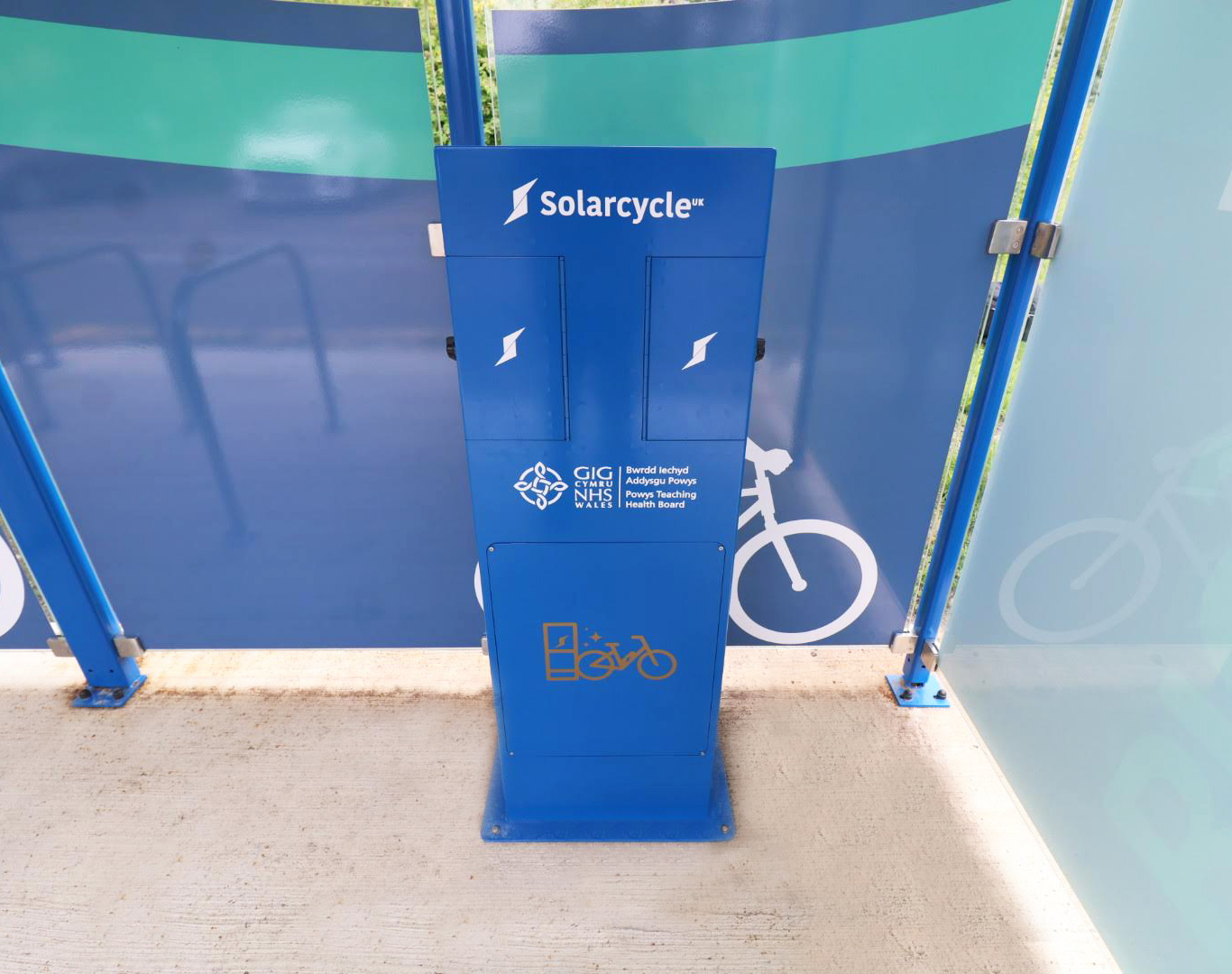
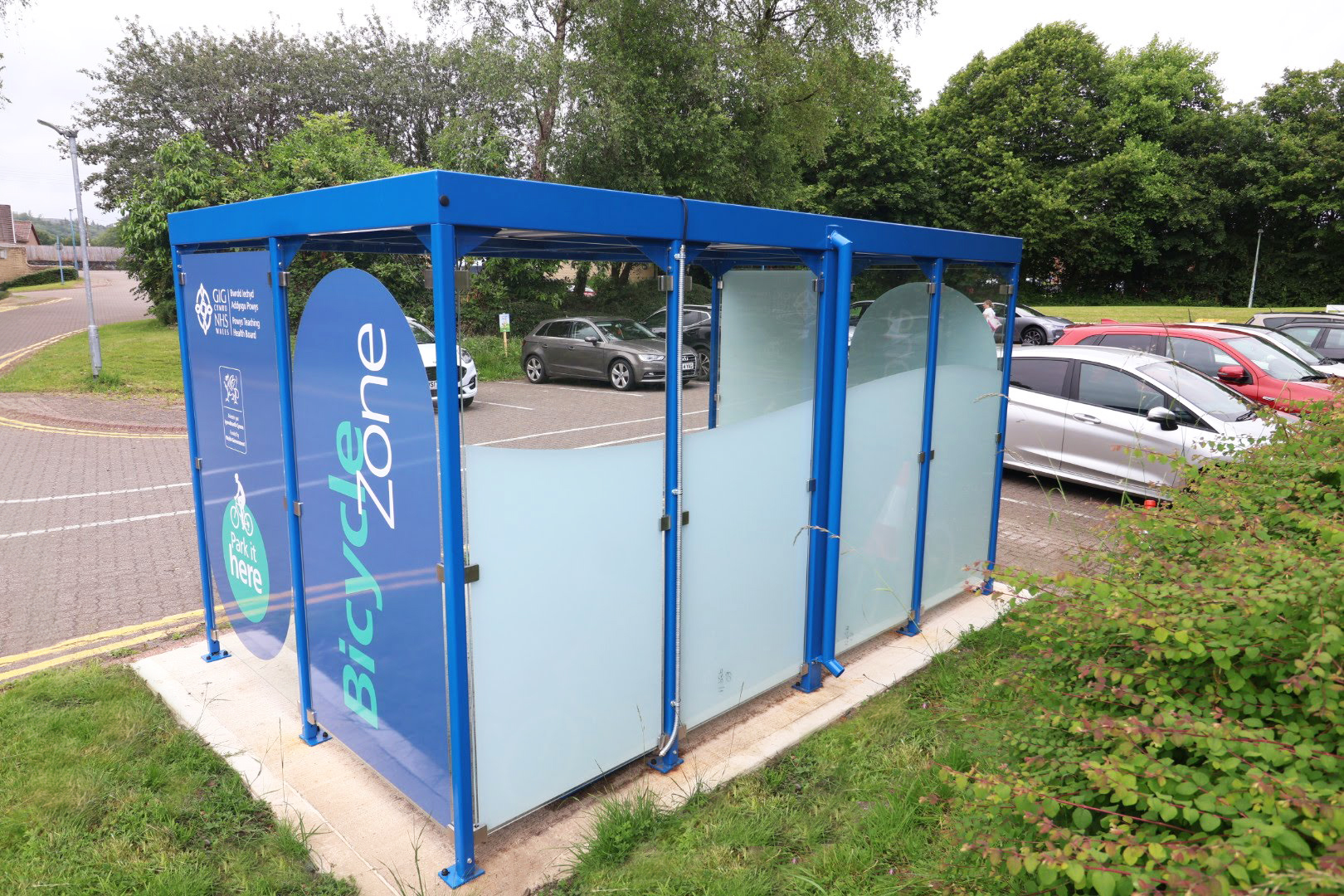
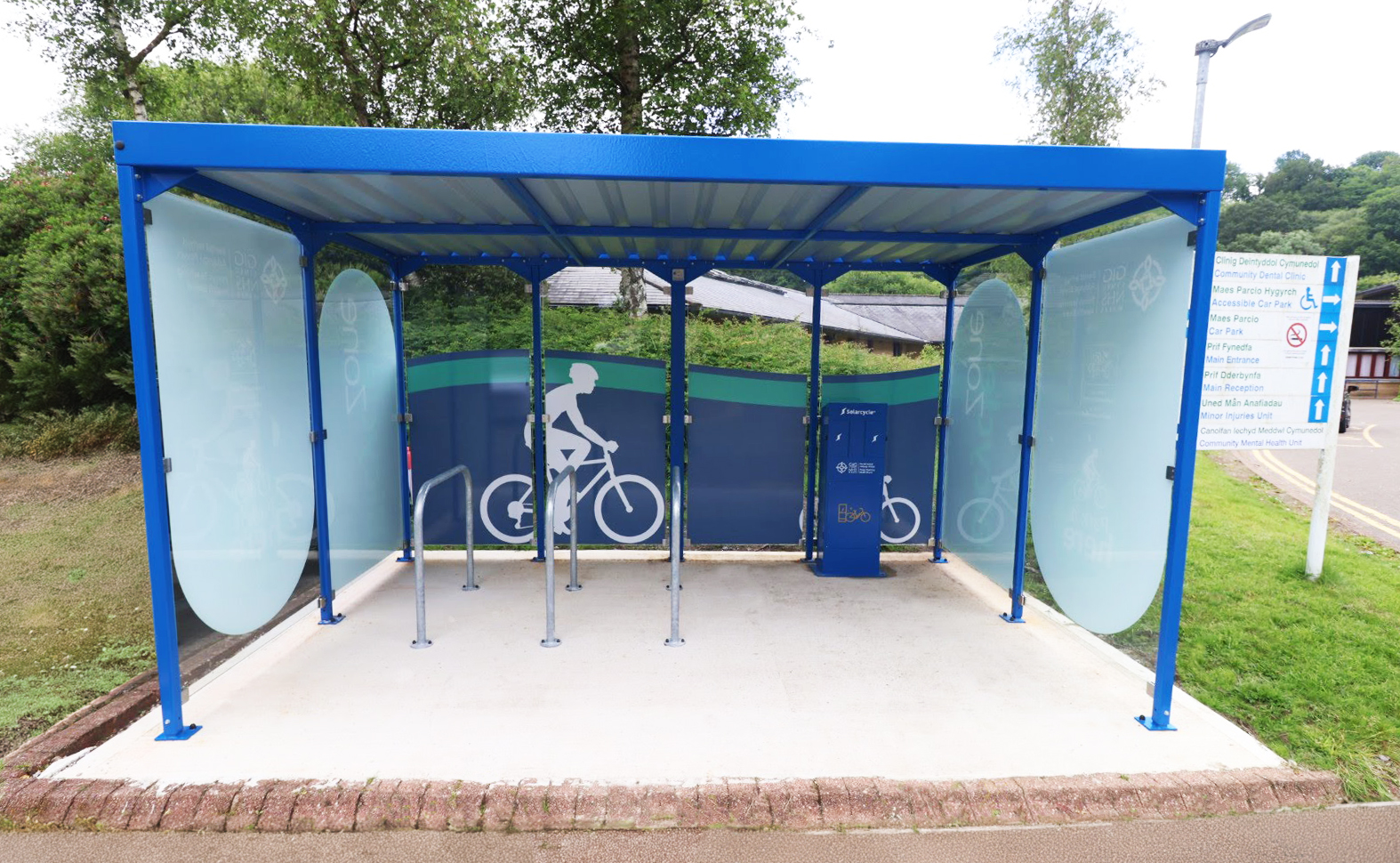
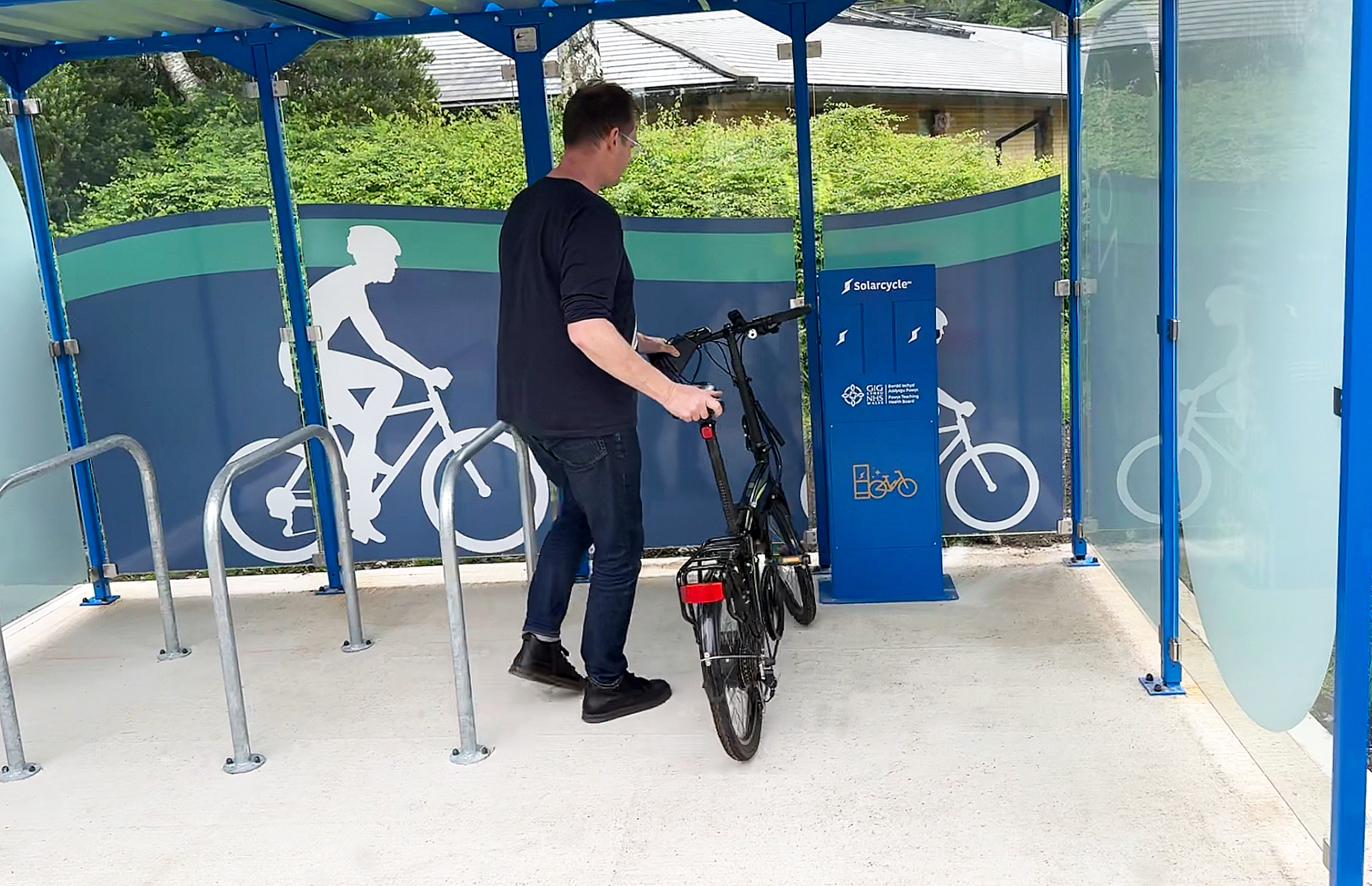
1st July 2024 – In a groundbreaking effort to promote sustainability, Falco UK  has teamed up with Solarcycle UK  to introduce 100% renewable solar energy e-bike charging stations within their cycle shelters. The inaugural installation of this innovative system has been completed at NHS Wales Ystradgynlais Community Hospital, aligning with the hospital’s Active Travel and Green Plans.

Falco UK is the UK’s leading manufacturer and installer of secure cycle hubs, cycle shelters, bin stores, and street furniture. Solarcycle stands out with its award-winning world-first, off-grid, ‘solar-in-a-box’ e-bike chargers, offering green, renewable energy for e-bike charging. The collaboration between Falco UK and Solarcycle directly addresses the growing demand for accessible e-bike charging, providing businesses and organisations with an innovative, safe, and environmentally sustainable solution. 

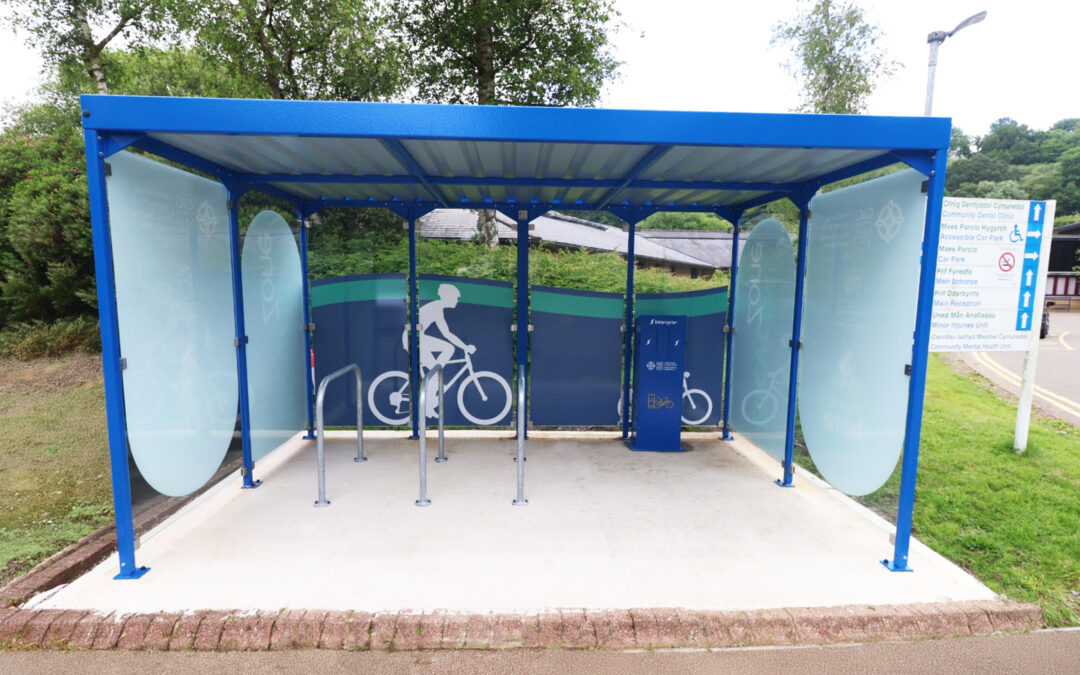
NHS Powys Teaching Health Board chose the FalcoLok shelter with Solarcycle’s e-bike charging system at Ystradgynlais Community Hospital for its immediate environmental benefits and minimal disruption. With its solar-powered and off-grid operation, the system requires no mains connection or trenchworks and generates no ongoing energy costs, providing free e-bike charging for all staff.  The collaboration with Solarcycle showcases Falco UK’s dedication to pioneering innovation and constant evolution of its cycle hubs to support businesses and organisations in their decarbonisation efforts.

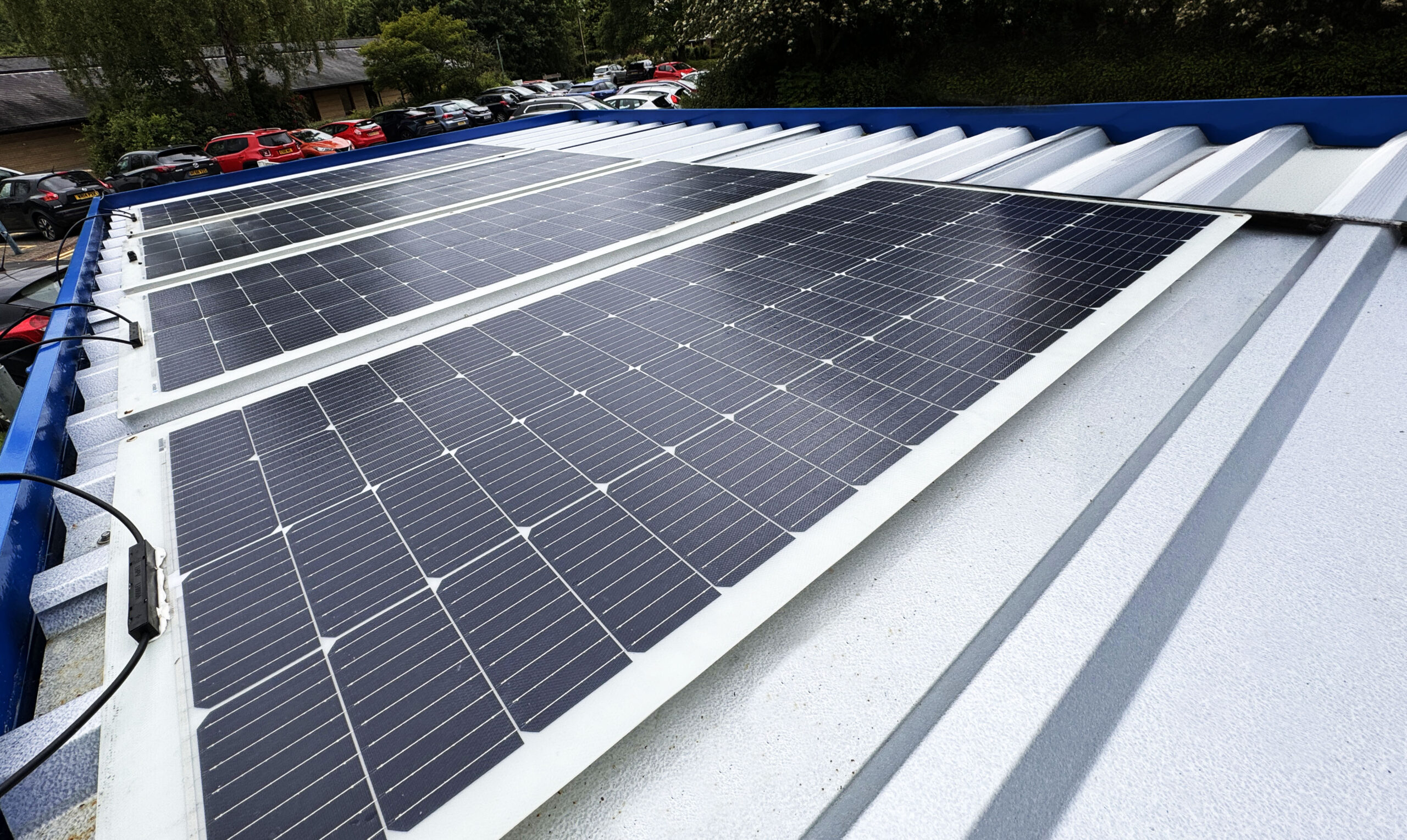
As the manufacturer Falco UK was able to work with SolarCycle to seamlessly integrate the PV array on the roof of the FalcoLok, then to connect the SoloarCycle charging pillar into the cycle parking area.

Solarcycle’s unique Reporting Function tracks the kWh of free, 100% renewable solar energy dispensed, enabling organisations to estimate how many carbonless miles have been generated by the organisation. As the only off-grid solar e-bike charging system with this feature, Solarcycle sets itself apart in the market.

“As we deliver our Health Board’s strategy for a Healthy Caring Powys, it is important as ever to measure, analyse and minimise the impact of our business on the biodiversity and sustainability within our operating areas. The recent installation of the Falco Solarcycle solar powered e-Bike charging points fits perfectly in with our values and commitments surrounding clean energy and also ensures that we remain at the forefront of new, green innovations. To be able to install these charging facilities without the need for any enabling works or mains electrical connections was also a real bonus for us from an operational standpoint and it’s been great to see our cyclists charging their bikes using 100% clean energy.” said Lloyd Morgan, Capital Programme Manager, Powys Teaching Health Board.

Rob Harper, Managing Director of Falco UK said: “At Falco, sustainability is at the core of everything we do. Our partnership with Solarcycle underscores our commitment to environmental stewardship, aligning seamlessly with Falco UK’s mission and strategic objectives. We do a lot of work in areas where grid constraints can pose challenges, and we are developing cycle hubs to support sustainable travel and tourism, so the off-grid nature of Solarcycle’s system stood out as a pivotal factor in our decision. Together with Solarcycle, we’re not just building cycle hubs; we’re shaping the future of sustainable transportation infrastructure.”

Paul Stratford, Founder and CEO of Solarcycle stated:

“Solarcycle designed e-bike chargers with versatility and affordability in mind. A product that transforms existing cycle shelters into e-cycle shelters and encourages more employees to enjoy active travel. With Falco’s sustainable product line and credentials, it made sense to join forces and help organisations reach NetZero. The result is a scalable product-line packed with reporting features for all organisations and budgets. As cyclists we’re excited to see Falco’s cycle shelters in more train stations, hospitals and workplaces. The data generated from these will help evidence the positive impact of e-bikes.”

The annual CO2 savings from carbon-free commuting with e-bike travel and Solarcycle charging are substantial. An organisation with 25 employees and a 15% e-bike adoption rate can save 3,252,000g of CO2 annually. This saving increases to 16,260,000g of CO2 for an organisation with 100 employees and reaches a staggering 731,700,000g of CO2 for an organisation with 4,500 employees.

Falco UK is a proud member of the NHS Shared Business Services Framework Agreement to provide cycle parking facilities to the NHS and public sector bodies. The framework is free to access for UK Public Sector organisations and provides a quick, simple, and compliant procurement route to market for sustainable Transport and Infrastructure solutions for the NHS and the wider public sector.

Falco UK and Solarcycle UK are setting a new benchmark in sustainable travel with their solar-powered e-bike charging solution. This innovative partnership addresses the growing demand for eco-friendly commuting, offering a cost-effective and disruption-free system that benefits both the environment and employees. By harnessing 100% renewable energy, organisations can track their sustainability progress and make a tangible impact on reducing carbon emissions. Falco and Solarcycle’s collaboration is a game-changer, driving the future of green transportation infrastructure.

Planning an E-bike Scheme?

Use our Business Case Kit packed with the latest facts and tools to help you build an internal brief or apply for funding.

NHS Case Study: Transforming the daily commute for NHS staff in Surrey

NHS Case Study: Transforming the daily commute for NHS staff in Surrey

NHS CASE STUDY: Transforming daily commutes of NHS staff in Surrey

With too many cars and too few car parking places, employees and patients at Ashford and St. Peter’s Hospitals have a challenge finding car parking spots.

Drivers scour the car park for parking spaces, causing traffic build-up and frustration. The resulting congestion affects staff, visitors and the local community.

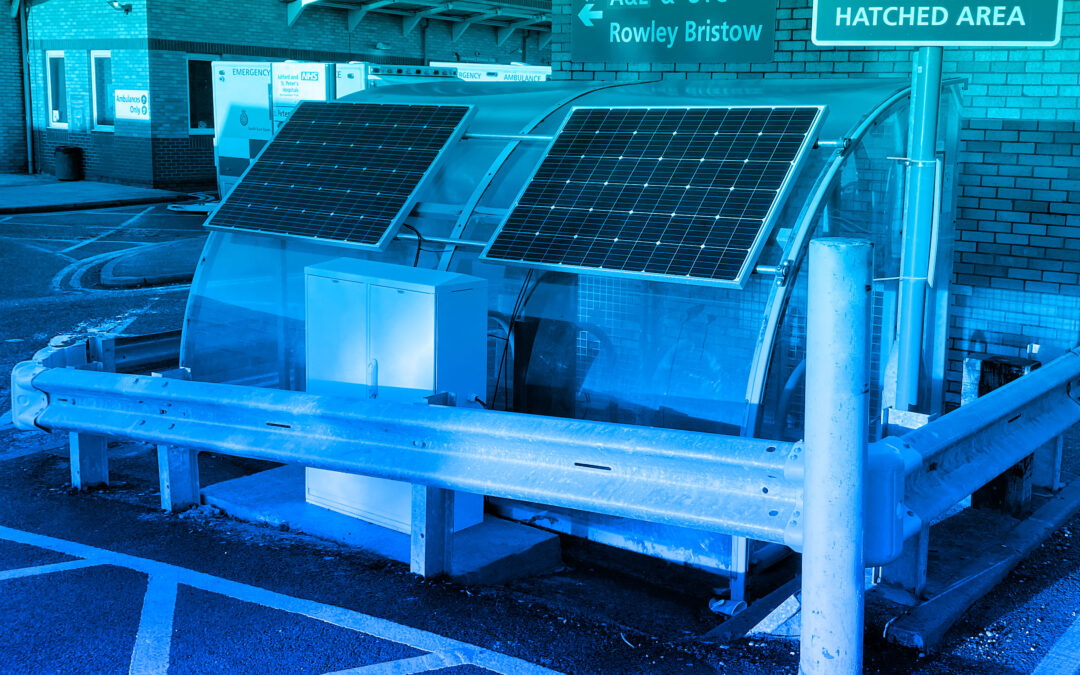
Quick to install and with no need for a mains connection, these solar powered charge points can be up and running in just one day.

Support for car-free commuting

Keen to reduce this problem, the Ashford and St Peter’s Hospital (ASPH) trust encourage car-free commuting with  cycling as a very popular option. Cycle-to-work finance schemes further incentivise ownership of bikes and e-bikes too. Staff now have the opportunity of an easier and cheaper car-free commute than ever before.


Avoiding high costs and disruption

Recognising the benefits of Ebikes, the facilities team at the trust started investigating the potential for Ebike charging points. These would be similar to electric vehicle charging points. However, this was more challenging than they hoped. Installing electric bike charging points is incredibly costly, with an outlay of £20k to just to route electric cables to the charging point, plus the cost of equipment and ongoing electricity supply. The installation would also be very disruptive. Routing electricity means digging up parts of the carpark and on-site road network, causing even more disruption to carpark users.

Solarcycle’s logical alternative

However, there was another solution – one with a fraction of the disruption and vastly lower costs. SolarCycle provides off-grid solar charging for electric bikes. Quick to install and with no need for a mains connection, these solar powered charge points can be up and running in just one day. And because they have no need for a mains connection, the installation and running costs are far lower than mains-connected charge points.

Quickly seeing the potential for SolarCycle’s Ebike charging points, the ASPH trust were keen to find out more. We explained that in addition to the minimal disruption and quick installation, they could provide this service to their staff free of charge – after all, the sun’s energy is readily available. This would be in addition to savings on fuel and parking charges, making the option an increasingly attractive staff benefit. This initiative would also support the Trust’s green targets by providing low carbon transport options.

A UK first for Ashford and St Peter’s Hospitals

The Ebike charging points were installed to the enormous satisfaction of the trust, with Ebike users already taking advantage of the new facilities.

Tom Smerdon, Director of Strategy and Sustainability at ASPH said, “It’s very exciting to see the Ebike charging points being installed here at the Trust, helping us reduce our carbon impact, improve our wellbeing and support local enterprise and innovation.”