Making the Business Case: Get Solar-Powered E-bike Charging

Making the Business Case: Get Solar-Powered E-bike Charging

Get Solar-Powered E-bike Charging in your organisation.

With the increasing popularity of e-bikes as a clean mode of transportation, it is now possible to reduce carbon emissions and improve sustainability while promoting healthy living. But, charging these e-bikes can be a challenge, especially when it comes to the cost and environmental impact of the charging infrastructure.

To truly reap the benefits of e-bikes, it’s important to have a reliable and cost-effective way to charge them. This is where Solarcycle’s ‘Business Case Kit’ comes in to provide a comprehensive package designed to help make the internal business case for solar powered e-bike charging.

In addition, we understand the funding process our audience can be facing. Our Business Case Kit is perfect to be included as part of your application for eligible grant funding from relevant local, regional, or national programmes, such as DEFRA’s £10.3m Air Quality Grant aimed at local councils to prevent pollution. The kit includes a range of tools and resources to support the environmental, financial, and organisational sustainability benefits of installing SolarPoint e-bike chargers.

BUSINESS CALCULATOR

One of the key features of the Business Case Kit is the Business Calculator, which includes credible research and key facts and figures on the environmental impact of reducing CO2 emissions by replacing cars with e-bikes. This tool allows businesses to understand the potential environmental benefits of switching to e-bikes, as well as the cost savings that can be achieved by reducing the need for cars.

INFOGRAPHIC POSTER

The Solarcycle Infographic Poster provides cost benefits of using free-to-use, 100% renewable solar energy for e-bike charging compared to traditional grid-connected charging stations. The infographic also highlights the savings businesses can make on installation costs, as SolarPoint eliminates the need for expensive groundworks, which can account for up to 60% of installation costs.

COMPARISON TABLE

The E-bike Charging Comparison Table directly benchmarks key features of traditional grid-connected e-bike charging vs custom-designed solar e-bike charging vs Solarcycle. This comparison helps businesses to understand the unique benefits of Solarcycle’s solution and how it compares to other options in the market.

DATASHEET

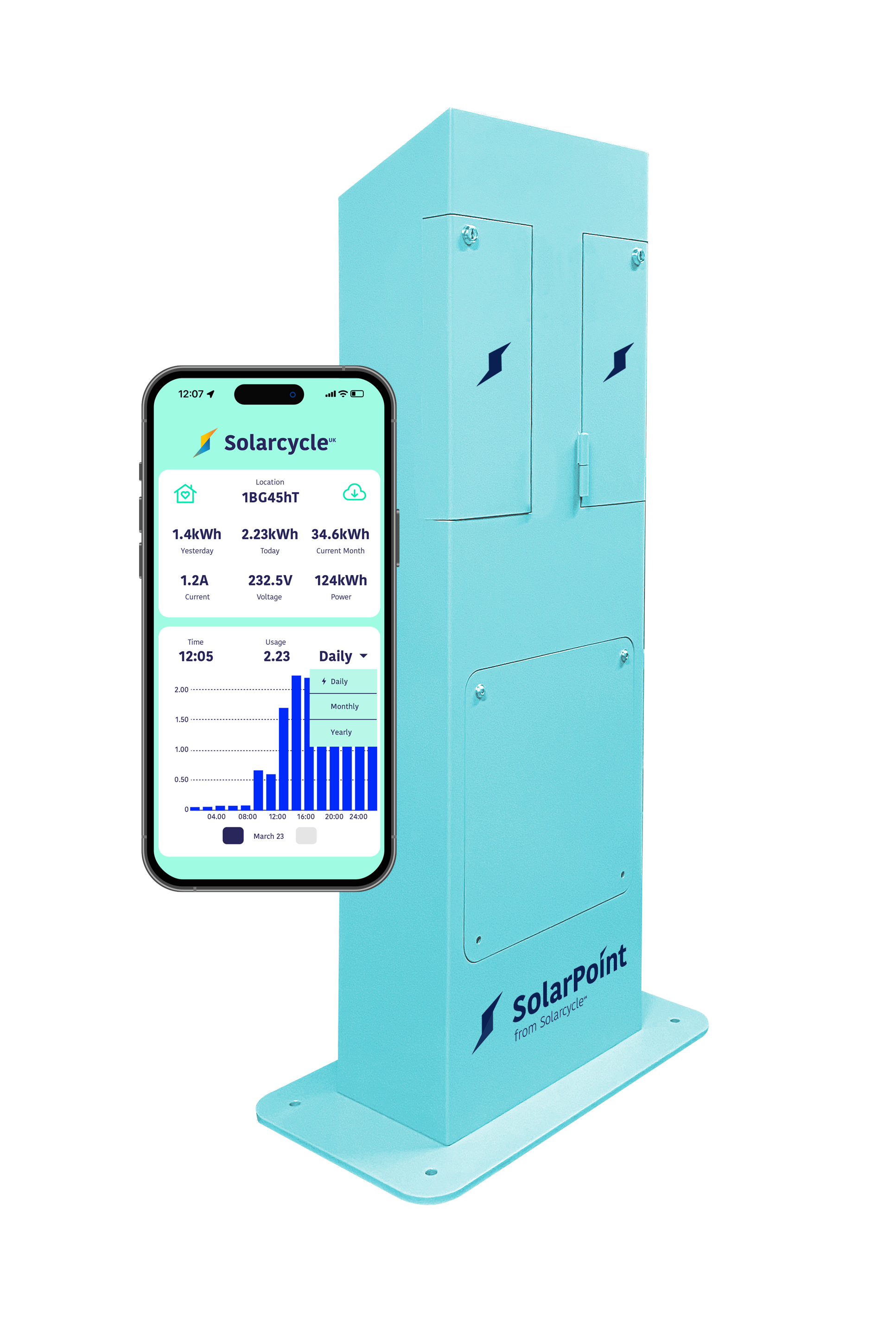
The SolarPoint Datasheet of our scalable ‘Twin’ e-bike charging station and PV solar panels provides businesses with a clear understanding of the technical specifications of Solarcycle’s solution. This enables you to plan and prepare for the installation of the e-bike charging stations at your organisation.

PHOTO LIBRARY

Photos of Solarcycle’s 100% renewable solar energy e-bike charging solution give a visual representation of the product, helping you to see how it fits into your business environment and how it can benefit the operations. These images showcase the quality and design of the Solarcycle solution, making it easier for businesses to imagine how the solution would fit into their own environment.

DATA SCREENSHOTS

Finally, screenshots of Solarcycle’s unique Reporting Function, measuring the kWh of free-to-use, 100% renewable solar energy dispensed as an essential feature for companies looking to measure the impact of their sustainability efforts. Organisations can track their progress towards their sustainability goals and make any necessary adjustments to their charging strategy. Solarcycle is the only off-grid solar e-bike charging system to offer this feature, making it a standout product in the market.

To get started, download the SolarPoint ‘Business Case Kit’ today and to bring solar-powered e-bike charging stations to your organisation

By installing Solarcycle’s e-bike charging stations, businesses can significantly and demonstrably reduce their carbon emissions. Solarcycle’s solar-powered charging stations ensure that e-bikes are charged with renewable energy, meaning that businesses can operate their charging stations without emitting any harmful greenhouse gases.

With no on-going energy costs, businesses can save money on their energy bills, making it a cost-effective option for businesses looking to save money while reducing their carbon footprint. What’s more, the low installation cost of Solarcycle’s e-bike charging stations makes it a cost-effective option for any business and organisation looking to go green.

businesses Installing Solarcycle’s e-bike charging stations, can significantly (& demonstrably) reduce their carbon emissions.

Beyond the environmental and cost benefits of solar e-bike charging, encouraging employees to use e-bikes instead of cars or buses can lead to significant health and organisational benefits. Regular exercise has been proven to improve mental health, reduce stress, and increase productivity. With e-bikes, employees can enjoy a low-impact exercise while commuting to work, improving their overall health, well-being, and productivity. 

The benefits of installing Solarcycle’s e-bike charging stations are clear. With no on-going energy costs, low installation costs, financial savings, and sustainability benefits, it’s an excellent option for businesses looking to reduce their carbon footprint while saving money. To get started, download the SolarPoint ‘Business Case Kit’ today and to bring solar-powered e-bike charging stations to your organisation. Let’s work together to make the world a greener, healthier, and more sustainable place.


Discover how staff at Ashford and St Peter’s are transforming the daily commute for NHS Staff ➔

Get Solar-Powered E-bike Charging! 

Going the Extra Mile: Why Incorporating E-Bikes is Key to Boosting Organisational Sustainability

Going the Extra Mile: Why Incorporating E-Bikes is Key to Boosting Organisational Sustainability

Going the Extra Mile:

Why Incorporating
E-Bikes is Key to
Boosting Organisational Sustainability

The UK has pledged in law to get to net-zero carbon emissions by 2050 …

Surface transport alone now represents 27% of the UK’s total domestic greenhouse gas emissions, making it the number one source of CO2. To get to net-zero, we need to rethink how we travel. With the Government’s Net Zero 2050 cycling sustainability aims, e-bikes will have an important role to play in making this goal achievable.

As companies and organisations put in place sustainability and ‘green’ plans, many are looking for ways to reduce their carbon emissions. One effective way to do this is by adopting e-bikes for employees and their transport fleet. First and foremost, e-bikes are an environmentally friendly mode of transportation. 

According to the European Cyclists’ Federation, buses emit 101 grams of CO2 per passenger-km, cars emit 271 grams, while e-bikes emit 22 grams per passenger-km. When charged with renewable solar energy from Solarcycle, they produce zero emissions, and they require less energy to operate than traditional vehicles. 

E-BIKE =

22 Grams CO2

BUS =

101 Grams CO2

CAR =

271 Grams CO2

[E-bikes] When charged with renewable solar energy from Solarcycle, produce zero emissions, and require less energy to operate than traditional vehicles.

By incorporating e-bikes into their transport fleet, companies can significantly reduce their carbon emissions and contribute to a cleaner, greener environment. In promoting the use of e-bikes, companies can encourage sustainable transportation and reduce their reliance on fossil fuels. This is particularly important considering the urgent need to transition to a low-carbon economy.

Furthermore, e-bikes can be a cost-effective solution for companies looking to reduce transportation costs. E-bikes are cheaper to operate, so by replacing cars with zero emission e-bikes, companies can save money on fuel and maintenance costs, while also contributing to a more sustainable future. Several companies have already adopted e-bikes as part of their transportation fleet. For example, DHL Express has deployed over 14,000 e-bikes in 58 countries worldwide. The company has reported that e-bikes have reduced carbon emissions by up to 16,000 tons per year, as well as reduced transportation costs and achieved a 14% increase in delivery efficiency. Similarly, Amazon has invested in e-bikes to reduce the carbon footprint of its delivery operations.

Another advantage of e-bikes is that they can help organisations improve their corporate image. The recent Mintel Sustainability Barometer Report shows 36% of consumers surveyed believe companies are ultimately responsible for reducing emissions from vehicles. Adopting e-bikes as a sustainable mode of transportation demonstrates a commitment to environmental sustainability and corporate responsibility. Customers, stakeholders, and employees are increasingly concerned about sustainability, and companies that prioritise sustainability are more likely to attract and retain customers and employees.

According to the European Cyclists’ Federation, buses emit 101 grams of CO2 per passenger-km, cars emit 271 grams, while e-bikes emit 22 grams per passenger-km.

As companies look to reduce their carbon footprint and increase their corporate responsibility, it’s time to consider the adoption of e-bikes for employee transportation and fleet operations. By making this switch, your company can take significant steps towards achieving net-zero emissions, while also demonstrating a commitment to sustainability and social responsibility. By investing in e-bikes, you can not only contribute to a cleaner environment but also create a more sustainable future for your business.

The environmental benefits and cost breaks e-bikes provide are undeniable. With e-bikes as a sustainable mode of transportation, we can move closer to a cleaner, healthier, and more sustainable future.

So, if you’re ready to take action towards a net-zero future and make a measurable positive impact on your community and the environment, start by fully exploring the potential of e-bikes and solar e-bike charging as part of your sustainability strategy for your company today.

Solar E-Bike Charger Installation – Isle of Arran

Case Study: Solarcycle UK Solar E-Bike Charger Installation on the Isle of Arran. Proving Solar Viability in Remote Scotland – Best-Performing UK Site Supports Eco-Tourism

Active Travel Aids Planning Consent at UK Research Campus

Case Study: Active Travel Aids Planning Consent at UK Research Campus. Solarcycle Solar E-Bike Charger Enables Compliant, Low-Impact Installation.

Active Travel’s Green Mark

What’s Active Travel’s Green Mark Accreditation? Solarcycle’s internationally recognised environmental certification for sustainable e-bike charging efforts.

Join the fastest growing Solar E-bike charging network

[JOIN US]The fastest growing Solar E-bike charging networkWhether you're an organisation looking to reduce your carbon footprint, a municipality aiming to promote sustainable transport, or just passionate about cycling and green technology, Solarcycle is your partner...

A new E-bike charging network for this UK Campus

[Case study]Charging E-bikes for a campus with 32x e-bikes Safely away from buildings24th Ocober 2025 -  Situation: This campus already had a fleet of existing electric scooters with a max range of 4 miles. However, this wasn't sufficient to cover the 10-mile-wide...

NHS Case Study with Scope 3 Emissions

[NHS Case study]Scope 3 Active Travel Data + 8x extra parking spaces for patients and staff24th Ocober 2025 -  BF Energy partner with Solarcycle to enhance NHS cycle shelters with 100% Solar powered e-bike chargers in Oxford. 24th October 2025 – BF Energy, the...

How to specify off-grid e-bike charging at your Workplace

[Downloadable PDF]How to Specify Off-Grid E-Bike Charging for Your WorkplaceBy Paul Stratford October 2025As UK organisations continue to prioritise sustainability and active travel, the demand for reliable e-bike charging infrastructure has never been higher. For...

UK E-bike Market Perspective 2026

[PERSPECTIVE]The UK E-bike Market 2025-26By Paul Stratford October 2025Firstly a warning. I haven't used AI. Apologies for any grammatical errors - although, it may add an element of "spot the error" for the grammar police, and positive data for everyone else. This...

Unleashing the Power of an E-Bike Demo Day

E-Bike Demo Days – transforming the way people move—literally moved by the environment.

Denbies Wine Estate – Solar E-Bike Charging for Sustainable Transport

The UK’s 1st Net Zero wine producer, Denbies Wine Estate is pioneering with Solarcycle’s innovative 100% green, off-grid solar-powered E-bike charging for all e-cyclists on Cycling UK’s Greensand Way

Falco & Solarcycle partner for 100% Renewable E-Bike Charging, NHS Wales

[PRESS RELEASE] In a groundbreaking effort to promote sustainability, Falco and Solarcycle offer 100% solar e-bike charging in NHS Wales cycle shelters

How Organisations Win with Active Travel

Staff, Workplaces & Society all win when switching from cars to e-bikes. From Employees’ Well-being, to the environment and even the organisation’s bottom line

Solarcycle UK Expands E-bike charging to Europe with Launch of Solarcycle Iberia in Spain

[PRESS RELEASE]Solarcycle UK Expands to Europe with Launch of Solarcycle Iberia in SpainSolarcycle UK proudly announces the high momentum launch of Solarcycle Iberia, marking a significant stride in sustainable transportation infrastructure.  With five of its...

Solarcycle.UK Scoops Award for Smarter Transport at Crest Business Awards.

Solarcycle.UK honoured with prestigious Smarter Transport award at Crest Business Awards held at WWF-UK’s Living Planet Building in Woking November 26th, 2023.

The enormous benefits of the Cycle to Work Scheme

With the Green Commute Initiative (GCI), the Cycle to Work scheme is quick and easy to use, saving 32 – 47% on a new bike and accessories AND 13.8% NIC as employers. Solarcycle Guest Blog

Gear Up with These Cool Gadgets for Cyclists and E-Bikers

Cool Gadgetsfor Cyclists and E-Bikers Here at Solarcycle, we are passionate cyclists. Are you a cycling or e-biking enthusiast who loves exploring new routes, taking in scenic views, or simply commuting to work on two wheels? Well, we've got you covered with a...

How Riding an E-Bike Can Boost Employee Wellness and Productivity

How Riding an E-Bike Can Boost Employee Wellness and Productivity

HOW: Riding an E-Bike Can Boost Employee Wellness and Productivity

Riding an e-bike is a fun and convenient way to get around, but did you know that it also has numerous health benefits for employees?

In addition to reducing the carbon footprint and saving money on transportation costs, e-biking has been shown to have positive effects on both physical and mental health. Recent studies highlight the benefits of e-bike use as one specific way to change commuter habits and in turn to improve health and well-being among urban and regional populations.  Let’s take a closer look at the health benefits of riding an e-bike for employees.

Physical Health Benefits
Travel is an essential part of everyday life for most people, and the adoption of active travel represents an efficient way to increase daily physical activity. Due to a growing body of evidence, the UK National Institute of Health and Care Excellence (NICE) now endorse active travel, with a particular focus on commuting, as a feasible method to incorporate physical activity into daily life to improve public health.

One of the most obvious benefits of riding an e-bike is the physical exercise it provides. To stay healthy, the UK Chief Medical Officers’ Physical Activity Guidelines state that adults should try to be active every day. Over a week, activity should add up to at least 150 minutes (2½ hours) of moderate intensity activity in bouts of 10 minutes or more – one way to approach this is to commute by e-bike.


Due to a growing body of evidence, the UK National Institute of Health and Care Excellence (NICE) now endorse active travel, with a particular focus on commuting, as a feasible method to incorporate physical activity into daily life to improve public health.

While e-bikes provide assistance with pedalling, they still require the rider to exert effort and pedal. This can help employees stay active and increase their daily physical activity levels, which has numerous benefits for overall health. Studies have shown that regular exercise can help reduce the risk of chronic conditions such as heart disease, obesity, diabetes, and even certain types of cancer.

Furthermore, riding an e-bike can be easier on the joints and muscles compared to traditional biking, as the motor assistance can help reduce strain and fatigue. This makes e-bikes a great option for those who may have physical limitations or injuries that make traditional biking difficult. It can also help with weight management and improve overall fitness.

the average UK worker takes 4.5 sick days a year; the average cyclist just 2.4 sick days a year.

Mental Health Benefits
In addition to the physical benefits, riding an e-bike can also have positive effects on mental health. One study examining the health benefits of electrically assisted cycling found that participants who regularly rode e-bikes reported decreased stress levels and increased feelings of well-being. The theme ‘mental well-being’ emerged from the participants’ descriptions concerning the positive effect of riding an e-bike. This is likely due to the combination of exercise, fresh air, and the feeling of freedom and control that comes with riding a bike. Exercise has been shown to improve mood and reduce symptoms of anxiety and depression. This is because exercise releases endorphins, which are chemicals that make us feel good.

Commuting can be stressful, but riding an e-bike can provide a more enjoyable and less stressful alternative to driving or taking public transport. Being outdoors and getting fresh air can also have positive effects on mental health. Moreover, e-biking can be a great way to incorporate mindfulness into a daily routine. Mindfulness involves being present in the moment and paying attention to the surrounding environment. When riding an e-bike, employees can focus on the experience of biking, taking in the scenery and enjoying the ride, which can help reduce stress and anxiety.

Productivity Benefits
Studies have shown that regular exercise can boost cognitive function and improve focus and concentration. Riding an e-bike for carbonless commuting can help employees stay fit, reduce stress levels, and improve mental clarity. In turn, these benefits can help employees be more productive at work by increasing energy levels, improving focus, and reducing sick days. According to research by Sustrans, the average UK worker takes 4.5 sick days a year; the average cyclist just 2.4.

Additionally, riding an e-bike can help employees save time and avoid traffic, making them more punctual and reducing stress associated with being late. This can also improve work productivity, as employees who are less stressed and more punctual are generally more productive. With an e-bike, employees can save on fuel costs, parking fees, and public transportation fees. This can free up extra funds that employees can use to invest in their career or personal growth.

Riding an e-bike to work can provide a range of health and productivity benefits for employees. From timesaving to improved physical and mental health, e-bikes offer a cost-effective and eco-friendly way to commute that can help employees be more productive, efficient, and focused in the workplace. As such, employers may want to consider offering e-bike incentives and amenities, such as free-to-use solar e-bike charging, to help their staff make the most of this clean and carbonless commuting option.


Discover how staff at Ashford and St Peter’s are transforming the daily commute for NHS Staff ➔

How Employers Can Promote E-bike Adoption

How Employers Can Promote E-bike Adoption

How
Employers
Can Promote
E-bike Adoption

There are many obvious reasons why employers should encourage their employees to adopt e-bikes for the benefit of the organisation and staff.

E-bikes are the perfect tool to attract many people, who don’t want to be a cyclist, out of the car.

  • Cost savings: E-bikes can be a cost-effective mode of transportation, reducing the costs associated with car ownership, such as fuel, parking, and maintenance expenses.
  • Improved health: E-bikes provide an opportunity for employees to get physical activity, reducing the risk of health problems associated with sedentary lifestyles.
  • Increased productivity: By reducing stress levels and improving overall health, e-bikes can increase employee productivity and satisfaction.
  • Reduced traffic and delays: Travelling by bike avoids traffic delays, so commuters arrive on time and leave the roads for cars who need to be there.
  • Reduced environmental impact: E-bikes produce significantly fewer emissions than traditional vehicles, especially when they are powered by the sun, helping organisations to reduce their carbon footprint and contribute to a more sustainable future.
  • Attraction and retention of employees: By promoting e-bikes, organisations can show that they care about their employees’ health and well-being and may be more attractive to environmentally conscious employees.

According to a recent report by Shimano, examining the attitudes towards e-bike usage, economic factors are seen as the strongest encouragement for buying or using an e-bike more.

 Employers can implement various initiatives and programmes to help their staff switch to carbonless commuting with an e-bike. Providing financial incentives, such as tax benefits, subsidies, or bonuses, for employees who choose to commute via e-bike are seen as the most important factor. According to a recent report by Shimano, examining the attitudes towards e-bike usage, economic factors are seen as the strongest encouragement for buying or using an e-bike more. On average across Europe, 47% see the cost of living as primary motivation and 41% see purchase subsidies as an encouragement to more e-bike use.

Other benefits employers can offer are the provision of secure and convenient bike storage and free-to-use charging facilities for staff who use e-bikes. Allowing flexible work hours to accommodate the needs of e-bike commuters who may need to arrive a little earlier or later due to their mode of transportation. Partnering with local e-bike dealerships to offer discounts and special promotions to employees.

Encouraging the use of e-bikes by setting an example and promoting them as a sustainable and cost-effective mode of transportation. Offering training and support to employees who are new to e-bikes, such as safety training, maintenance workshops, cycling clubs and organised ride events. By promoting e-bike use, employers can help their staff save money, improve their health, and reduce their carbon footprint, ultimately leading to a more sustainable and cost-effective mode of transportation.

Helping employees to adopt e-bikes can have numerous benefits for both the employees and the organisation. Incentives not only make it easier for employees to adopt e-bikes, but they also show that the organisation is committed to promoting sustainable and healthy modes of transportation. By implementing such incentives, employers can create a more productive and engaged workforce while also helping to reduce their environmental impact. So, if you are an employer looking to promote e-bike adoption among your employees, you need to put in place the right incentives that make the transition easier and more appealing.

According to the Bicycle Association, the evidence shows that around half of all trips by e-bike replace a trip that would have been made by car. The time is right therefore for employers to kick-start e-bike uptake with the right incentives and be part of the wider clean transport revolution.


Helping employees to adopt e-bikes can have numerous benefits for both the employees and the organisation.

E-Bikes: As an Affordable Solution to the Cost of Living Crisis

E-Bikes: As an Affordable Solution to the Cost of Living Crisis

E-Bikes: As an Affordable Solution to the Cost of Living Crisis

As the cost of living continues to rise, more people are searching for ways to cut expenses and save money.

A recent survey published by Mintel confirmed that 55% of respondents pointed to petrol/diesel costs, alongside steady increases in public transport bills as a reason to consider the switch to e-mobility.

E-bikes offer significant savings on commuting and transport costs as an alternative to running a car. With the ability to travel further distances than a traditional bicycle, without the need for car maintenance, e-bikes offer an obvious solution to the cost of living crisis. E-bikes are not only helping people save money and live more sustainable lives, but they also have the potential to significantly reshape the transportation landscape.


Here are the key benefits of e-bikes to consider for the cost-conscious consumer:

  • Lower operating costs compared to a car with reduced spending on fuel, maintenance, parking costs, insurance, and repairs.
  • Easier and more affordable transportation for commuting, running errands, and other everyday activities.
  • Improved access to job opportunities: e-bikes can provide people with a reliable and affordable means of transportation, which can improve access to job opportunities, especially for those living in urban areas with high transportation costs.
  • Better health: Regular cycling can help to improve health and reduce healthcare costs, providing a long-term cost benefit to individuals and society as a whole.
  • Reduced dependence on fossil fuels: by using renewable energy sources, such as batteries and solar e-bike charging stations, e-bikes can reduce dependence on fossil fuels.

At Solarcycle, we urge consumers, policymakers, employers and other stakeholders to consider the benefits of e-bikes and to embrace them as a viable option for a more affordable and sustainable future.

As more people recognise the benefits of e-bikes, the adoption of this mode of transportation is likely to increase, making it an important part of the solution to the cost of living crisis. At Solarcycle, we urge consumers, policymakers, employers and other stakeholders to consider the benefits of e-bikes and to embrace them as a viable option for a more affordable and sustainable future.

For consumers, we encourage you to think about the potential savings that e-bikes can offer over cars and public transport, and to give them a try as a way to get around. For policymakers, we ask that you prioritise policies that support e-bikes, including dedicated bike lanes and tax incentives for e-bike purchases. Employers can play a crucial role by providing free-to-use e-bike charging facilities and infrastructure for their employees. By doing so, they not only encourage sustainable transportation options but also promote a healthier lifestyle for their staff. Finally, for other stakeholders, such as urban planners and developers, we encourage you to consider the important role that e-bikes can play in creating more sustainable and liveable communities.

Together, we can work towards a future where e-bikes are a mainstream mode of transportation, helping to reduce our reliance on cars, improve our quality of life, and create a more sustainable, healthier, and equitable future for all.

55% of respondents pointed to petrol/diesel costs, alongside steady increases in public transport bills