
[PRESS RELEASE]
Solarcycle Demonstrates the Future of Sustainable Tourism
with High-Performing E-Bike Charging Installation on the Isle of Arran
Remote Scottish island showcases how renewable-powered, data-driven mobility infrastructure can support eco-tourism without costly construction or grid connections
Isle of Arran, Scotland – 15th June 2026 – Solarcycle Ltd has completed the installation of a free-to-use solar-powered e-bike charging station at the Isle of Arran Community and Visitor Centre, creating a sustainable mobility hub on one of the UK’s most remote and environmentally significant tourism destinations.
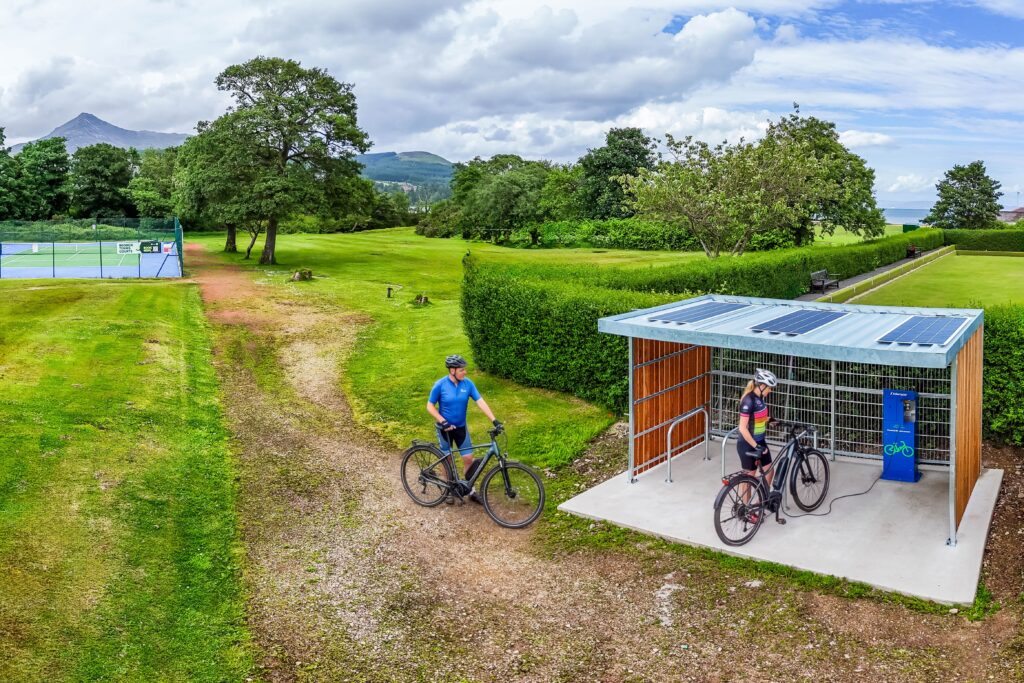
Solarcycle E-bike Charger, Isle of Arran
Located off Scotland’s west coast, the Isle of Arran attracts visitors from across the UK and beyond, drawn by its rugged landscapes, coastal routes, outdoor activities and rich natural heritage. As with many island communities, however, increasing visitor numbers bring transport challenges and a growing need for sustainable alternatives to private vehicle use.
The new Solarcycle installation enables visitors and residents to charge e-bikes using renewable energy generated on-site, encouraging low-impact exploration of the island while helping to preserve the very landscapes visitors come to experience.
The project has quickly become Solarcycle’s best-performing installation to date. The integrated solar panels consistently generate more than enough energy to meet charging demand, demonstrating the effectiveness of renewable-powered mobility infrastructure even in remote locations.
But the installation represents more than simply a charging point …
Every charging session contributes to Solarcycle’s growing dataset, helping the company understand where, when and why cyclists choose to charge their bikes. By analysing charging behaviour across a wide range of locations, Solarcycle is building valuable insight into e-bike usage patterns, seasonal trends, visitor behaviour and infrastructure demand.
This data helps destinations, employers, healthcare providers and visitor attractions better understand how cyclists interact with their facilities and informs future infrastructure planning.
“Charging infrastructure is only one part of the equation,” said Paul Stratford, CEO of Solarcycle. “The real value comes from understanding user behaviour. Every installation helps us build a clearer picture of how people use e-bikes in different environments, enabling us to advise organisations on demand, location suitability and future investment decisions.”
“Every installation helps us build a clearer picture of how people use e-bikes in different environments, enabling us to advise organisations on demand, location suitability and future investment decisions.”
Solarcycle’s predictive analytics draw on data including location type, weather patterns, topography, seasonality and usage trends to help organisations deploy infrastructure where it will deliver the greatest benefit.
The Isle of Arran project also highlights one of the key advantages of the Solarcycle system: simplicity of deployment.
Unlike traditional charging infrastructure, Solarcycle’s modular design requires no extensive groundwork, trenching or disruptive construction works. The units can be installed quickly and efficiently, making them particularly suitable for rural locations, visitor attractions and protected landscapes where minimising environmental impact is a priority.
The system can also be retrofitted to existing cycle shelters, allowing organisations to upgrade existing cycling facilities without replacing their current infrastructure or undertaking major redevelopment projects.
In addition, Solarcycle’s solar-powered architecture enables charging stations to be safely installed away from buildings, removing many of the challenges associated with electrical infrastructure while increasing flexibility in site selection.
“The Isle of Arran demonstrates exactly what makes the Solarcycle solution different,” Stratford continued. “We can deploy quickly, with minimal site disruption, no costly groundwork and no dependence on nearby buildings. Whether we’re installing on a remote Scottish island or at a busy visitor attraction, the process is straightforward, scalable and highly sustainable.”
The successful delivery of the Arran project also reflects Solarcycle’s nationwide installation capability. The company’s dedicated installation team routinely works in challenging and remote environments, ensuring organisations can access sustainable charging infrastructure regardless of location.
From the far northern reaches of the British Isles to the south of England, Solarcycle is helping destinations embrace active travel and sustainable tourism.
At Denbies Wine Estate in the South Downs, for example, Solarcycle has installed a free-to-use public e-bike charging station designed to encourage visitors to explore the estate and surrounding countryside by bicycle. The aim is not simply to provide charging facilities but to support cleaner, quieter and more environmentally responsible visitor experiences.
As eco-tourism continues to grow, destinations are increasingly recognising the role that cycling infrastructure can play in reducing environmental impact while enhancing visitor engagement. For island communities, rural regions and visitor attractions alike, sustainable mobility is becoming a critical part of long-term tourism resilience and economic sustainability.
Through a combination of renewable energy, modular infrastructure, rapid deployment and data-driven insight, Solarcycle is helping organisations across the UK build the foundations for a more sustainable future.
Request Hi-Res images?
300 dpi images available on request.
Case Studies
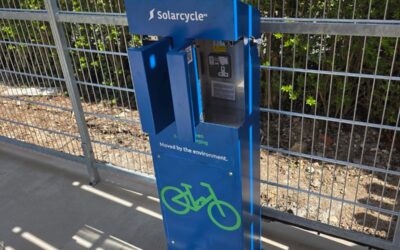
Solar E-Bike Charger Installation – Isle of Arran
Case Study: Solarcycle UK Solar E-Bike Charger Installation on the Isle of Arran. Proving Solar Viability in Remote Scotland – Best-Performing UK Site Supports Eco-Tourism
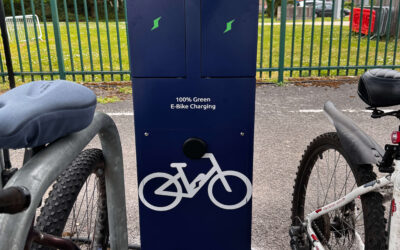
Active Travel Aids Planning Consent at UK Research Campus
Case Study: Active Travel Aids Planning Consent at UK Research Campus. Solarcycle Solar E-Bike Charger Enables Compliant, Low-Impact Installation.
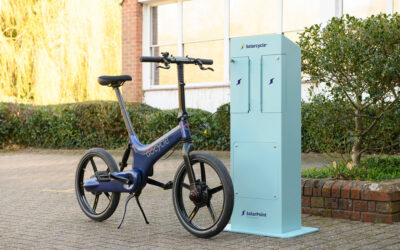
A new E-bike charging network for this UK Campus
[Case study]Charging E-bikes for a campus with 32x e-bikes Safely away from buildings24th Ocober 2025 - Situation: This campus already had a fleet of existing electric scooters with a max range of 4 miles. However, this wasn't sufficient to cover the 10-mile-wide...